

It’s one of the most common dilemmas in organizational development: your company has an employee with brilliant, unmatched knowledge in their technical domain, yet placing them in a formal leadership position is a recipe for friction, team turnover, and missed potential.
In psychological terms, this is often the distinction between technical intelligence (IQ) and emotional intelligence (EQ).
The “Lead” as a Technical Anchor
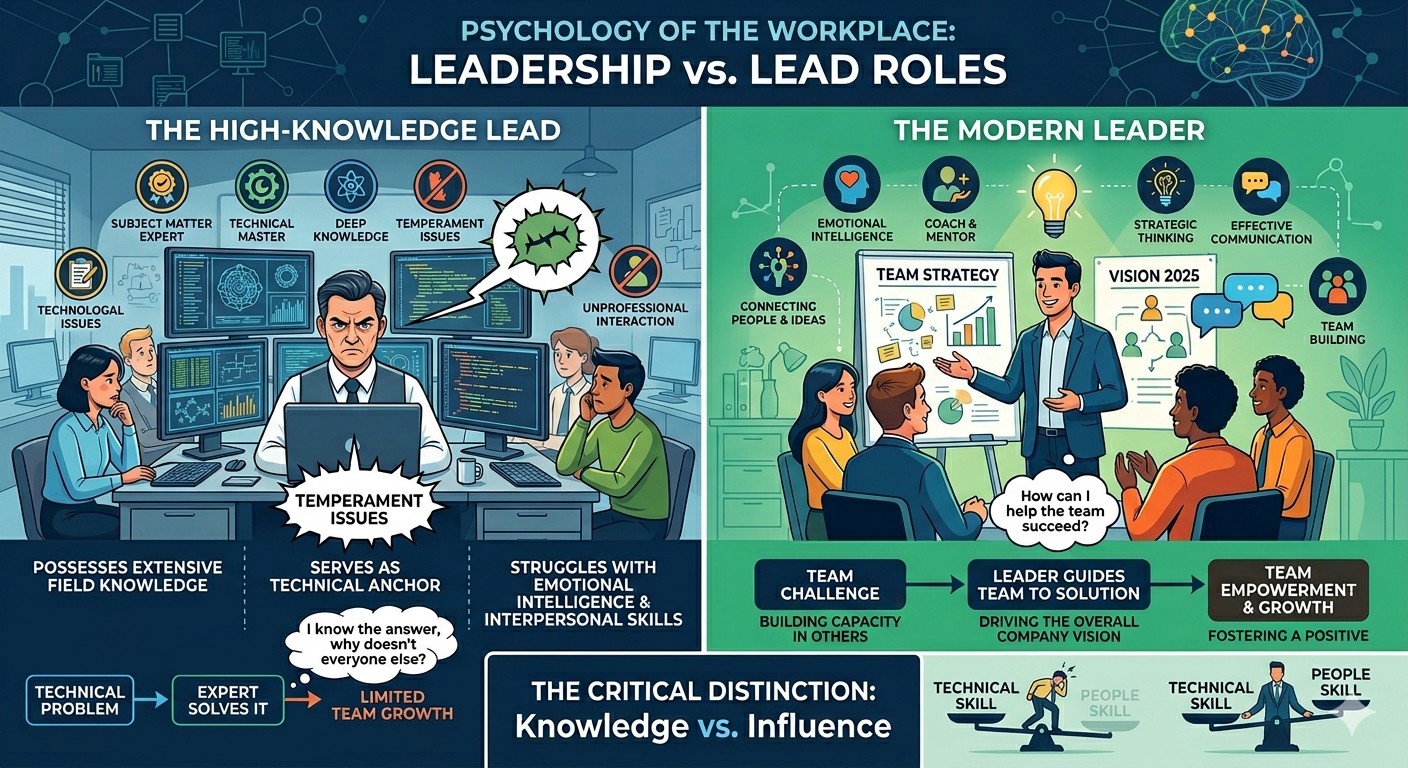
The person we often call a “Lead”—whether “Tech Lead,” “Team Lead,” or simply “Senior”—is often selected for their competence, not their charisma. As the graphic above illustrates, they are the Subject Matter Experts (SMEs). Their role is critical: they serve as the company’s technical anchor. When a complex problem arises that stymies the rest of the team, the Lead can be counted on to dive in and solve it. Their depth of knowledge is a pillar of the operational workflow.
However, the psychologist’s view reveals why they may plateau there. A brilliant expert may have significant “Temperament Issues,” as highlighted in our visual guide. Their internal thought process, often visible through non-verbal cues or blunt speech, might be: “I know the answer, why doesn’t everyone else?”
When communication becomes a series of sharp, transactional interactions, team development stalls. Instead of mentorship, there is an interaction style that can feel dismissive. While the problem gets fixed, the team doesn’t learn how to fix the next one.
The True Leader: A Bridge, Not a Solitary Pillar
Contrast this with the psychology of a true Leader. A leader might have less granular technical knowledge but possesses the core EQ traits: empathy, self-regulation, and powerful communication skills.
A true leader’s mindset, visualized on the right, is: “How can I help the team succeed?”
Instead of just solving problems, they:
- Coach & Mentor: They guide others to the answer, building long-term competence.
- Connect People & Ideas: They focus on the architecture of collaboration, not just the code.
- Foster a Positive Culture: They understand that psychological safety is non-negotiable for high performance.
A leader doesn’t just manage technical complexity; they balance it with people skills. They provide the team strategy and the ‘Vision 2025’ that provides direction, while the technical lead provides the blueprint.
Bridging the Gap
For organizations, the key takeaway from this psychological model is simple but crucial: Technical skills and people skills require two entirely separate skill sets and training paths.
You cannot promote someone into leadership solely because they are the best engineer, accountant, or designer. If you do, you lose an expert and gain a poor manager. Recognizing this critical distinction allows companies to create separate, but equally valued, career ladders—one for those who influence through knowledge, and one for those who influence through people. The health of your workplace culture depends on this understanding.