

An electrical transformer is a passive device that transfers electrical energy between two or more circuits using electromagnetic induction.
- Purpose: To increase (step-up) or decrease (step-down) voltage levels in AC systems.
- Core Components:
- Primary winding: Receives incoming voltage.
- Secondary winding: Delivers transformed voltage.
- Magnetic core: Facilitates efficient flux linkage.
- Key Principle: Based on Faraday’s Law of Induction—a changing magnetic field induces voltage in nearby coils.
- Common Types:
- Step-up transformer: Increases voltage.
- Step-down transformer: Decreases voltage.
- Isolation transformer: Provides electrical separation without changing voltage.
⚡ General Power Panels?
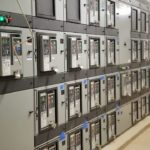
Power panels (also called electrical panels or distribution boards) are the central hubs for managing and distributing electricity within a building or facility.
- Function: Receive power from the utility or transformer and distribute it to various circuits.
- Main Components:
- Main breaker: Controls power to the entire panel.
- Circuit breakers: Protect individual circuits from overloads.
- Busbars: Conduct electricity to breakers.
- Neutral and ground bars: Provide return paths and safety grounding.
- Types:
- Main breaker panel: Includes a master shut-off.
- Subpanel: Extends circuits from the main panel.
- Motor Control Center (MCC): Controls motors in industrial setups.
- Power Control Center (PCC): Manages high-load equipment.
🔁 Difference Between Electrical Phases
Electrical phases refer to how power is delivered and distributed in AC systems. The most common are single-phase and three-phase.
| Feature | Single-Phase Power | Three-Phase Power |
|---|---|---|
| 🔌 Wires | 2 (Live + Neutral) | 3 (Live wires) + optional Neutral |
| ⚙️ Voltage | ~120V or 240V | ~208V, 400V, or 480V depending on setup |
| 🔄 Waveform | One sinusoidal wave | Three waves 120° apart |
| 🔋 Power Consistency | Pulsating delivery | Continuous, smoother delivery |
| 🏠 Usage | Homes, small offices | Industrial, commercial, heavy loads |
| ⚡ Efficiency | Less efficient for large loads | More efficient and balanced |
- Single-phase: Ideal for residential use and light loads.
- Three-phase: Preferred for industrial machinery, HVAC systems, and data centers due to its stability and efficiency.