

This is foundational knowledge for motor installation, troubleshooting, and voltage matching—especially useful in industrial settings.
🌀 Three-Phase AC Motor Winding
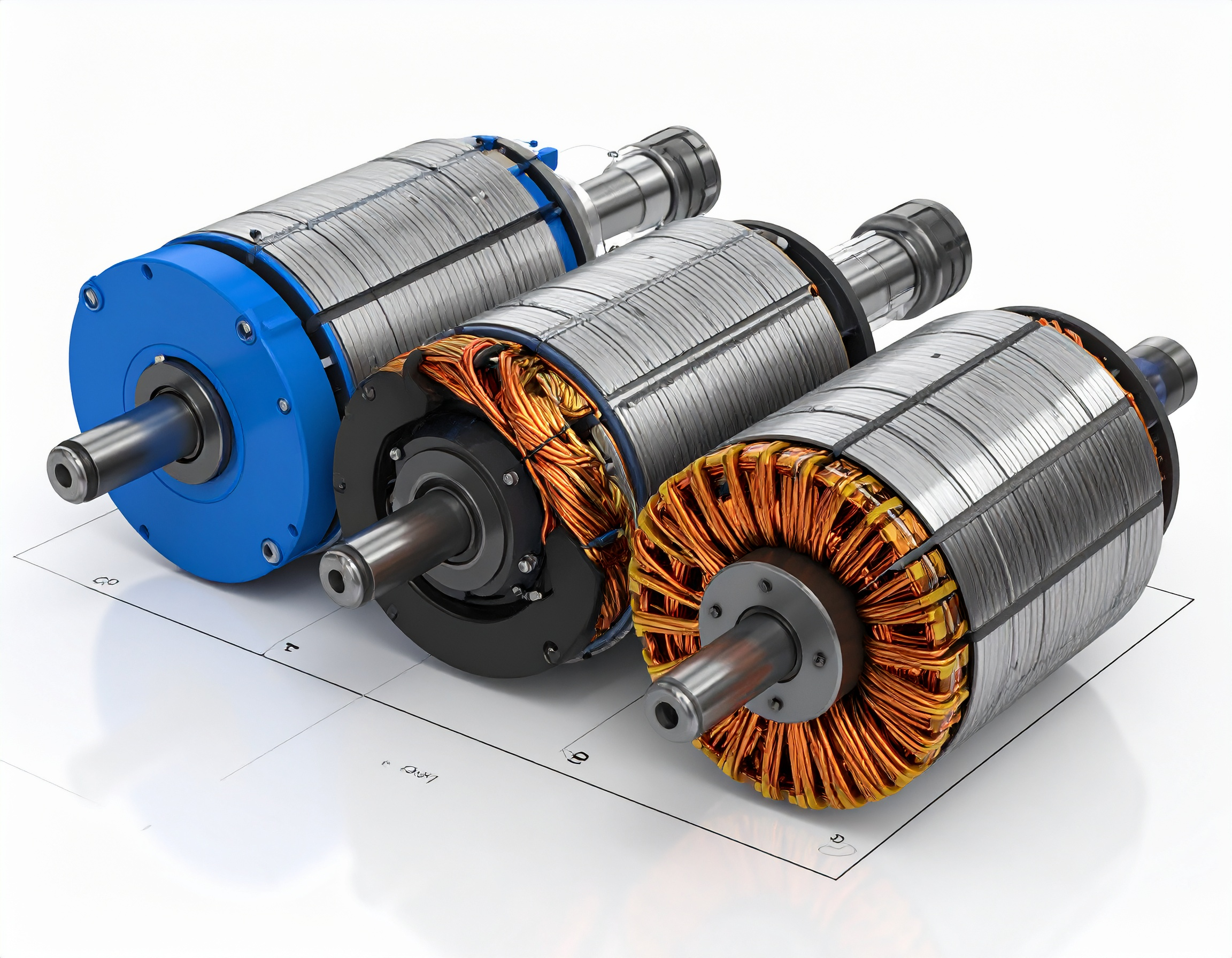
Three-phase AC motors have three sets of windings spaced 120° apart around the stator. These windings create a rotating magnetic field when energized by a three-phase power supply.
- Windings: Coils of wire wrapped around stator slots.
- Purpose: Convert electrical energy into mechanical rotation.
- Arrangement: Each winding corresponds to one phase—A, B, and C.
🔗 Common Winding Connections
There are two primary ways to connect the windings:
⭐ Wye (Star) Connection
- Configuration: One end of each winding is joined at a common neutral point.
- Voltage: Line voltage = √3 × phase voltage.
- Use Case: Preferred for high-voltage applications and smoother starts.
🔺 Delta Connection
- Configuration: Windings are connected end-to-end in a closed loop.
- Voltage: Line voltage = phase voltage.
- Use Case: Ideal for low-voltage, high-torque applications.
🧰 Graphic: Wye vs. Delta Motor Winding Diagrams
Here’s a simplified visual showing both configurations:
- Delta:
- Wye (Star)::

Each point (A, B, C) represents a winding terminal. In Wye, they meet at a neutral center. In Delta, they form a triangle loop.
visual showing how Star (Y) and Delta (Δ) connections differ—perfect for explaining transformer or motor wiring setups. It’ll highlight terminal arrangements, current paths, and how voltage behaves in each configuration
🔍 Why It Matters
| Feature | Wye (Star) | Delta |
|---|---|---|
| 🔋 Voltage Handling | Higher voltage, lower current | Lower voltage, higher current |
| ⚙️ Starting Torque | Lower | Higher |
| 🛠️ Applications | Fans, pumps, HVAC | Crushers, conveyors, compressors |
| 🧯 Grounding Option | Neutral available | No neutral |
Identifying Motor Leads
Three-phase motors usually come with 6 or 9 leads, depending on whether they’re connected in Wye or Delta, and whether they’re dual voltage.
Common Lead Configurations:
- 3 Leads: Standard single voltage motor
- 6 Leads: Can be configured for Wye or Delta
- 9 Leads: Dual-voltage motors (most common)
Lead Labels:
| Label | Phase Assignment (typical) |
|---|---|
| T1, T2, T3 | Line connections to the motor |
| T4–T9 | Internal winding connections |
For example:
- Low voltage (Delta): T1 to L1, T2 to L2, T3 to L3, T4-5-6 joined
- High voltage (Wye): T1 to L1, T2 to L2, T3 to L3, T7 to T4, T8 to T5, T9 to T6
Tip: Always consult the wiring diagram on the motor’s nameplate—it shows the correct connections for both high and low voltage setups.
🏷️ Decoding Motor Nameplate Data
Motor nameplates pack a lot of critical info. Here’s what to watch for:
| Field | Description |
|---|---|
| 🆔 Model Number | Unique identifier for the motor |
| ⚡ Voltage | Operating voltage range (e.g., 230/460V) |
| 🔄 Phase | Number of phases (typically 3) |
| ⚙️ HP (Horsepower) | Indicates mechanical output power |
| 🌀 Frequency | Typically 60 Hz in North America |
| 🔁 RPM | Speed (revolutions per minute) |
| 🧭 Frame | Mounting dimensions and enclosure type |
| 🔒 Service Factor | Tolerance for overload conditions |
| 🧮 Amps | Full load current at rated voltage |
| 🔌 Connection | Wye or Delta configuration |
| 🧯 Insulation Class | Thermal tolerance of winding insulation |
| 🌡️ Ambient Temp | Rated operating temperature |
| 🔥 Duty Cycle | Duration the motor can run under specific load |
Example:
Here’s a full breakdown of the Baldor Reliance Severe Duty XT motor nameplate you uploaded, Alexander—this motor packs serious specs designed for rugged, high-demand environments. Let’s interpret the key data so you or your team can quickly assess compatibility and setup needs:
⚙️ Nameplate Summary: Baldor Reliance XT Motor
| Label | Details | Explanation |
|---|---|---|
| CAT. NO. | XT3156T | Catalog number / model reference |
| FRAME | 284T | Indicates shaft dimensions and mounting style |
| VOLTAGE | 230/460V | Dual voltage—standard for 3-phase motors |
| FULL LOAD AMPS | 38.8 / 19.4 A | Amperage at each voltage rating |
| RPM | 1180 | Motor speed—indicates this is a low-speed unit |
| FREQUENCY | 60 Hz | Standard in North America |
| HORSEPOWER (HP) | 15 | Mechanical power output |
| PHASE | 3 | Three-phase motor |
| SERVICE FACTOR | 1.15 | Can handle 15% overload safely |
| NEMA EFFICIENCY | 91.7% | High energy efficiency rating |
| BEARINGS | DE 6311 / ODE 6309 | Bearing sizes for drive and opposite ends |
| ENCLOSURE | TEFC | Totally Enclosed Fan-Cooled—ideal for harsh sites |
| INSULATION CLASS | F | Supports up to 155°C temperature rise |
| MAG CUR | 17.2 / 8.6 A | Magnetic starter trip settings |
| POWER FACTOR | 77% | Reactive power performance |
| USABLE @ 208V | 42 Amps | Alternate voltage scenario |
| USABLE @ 50 Hz | 10 HP @ 190/380V | International compatibility |
| CONNECTION TYPE | Wye or Delta (based on wiring diagram) | Follows standard 9-lead setup conventions |
| MOTOR TYPE | Severe Duty XT | Built for hazardous conditions |
| LOCATION RATED | Class I Div 2, Zone 2 Groups A–D, IIA–IIC | Explosion-proof certification |
| INVERTER RATED | PWM – CC 010A | Compatible with variable frequency drives (VFDs) |
| TORQUE CODE | T3C | Starting torque classification |
| MANUFACTURER | ABB Motors – Fort Smith, AR, USA | Made in U.S.A. |
