

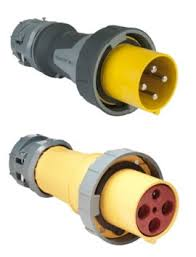
Difference between 100 Amp 208V and 100 Amp 480V shore power plugs for boats—especially useful when you’re working with marine electrical systems or advising clients.

🔌 Key Differences Between 208V and 480V, Pins, Labels, for Shore Power Plugs Chart:
| Feature | 100A 208V Plug | 100A 480V Plug |
|---|---|---|
| 🔋 Voltage Rating | 120/208V 3-Phase Wye | 277/480V 3-Phase Wye |
| ⚙️ Pin Configuration | 5 pins (L1, L2, L3, Neutral, Ground) | 5 pins (L1, L2, L3, Neutral, Ground) |
| 🟨 Color Coding (typical) | Blue or Black Stainless Steel housing | Yellow or Red Stainless Steel housing |
| 🧲 Pin Size & Shape | Slightly smaller pins | Larger pins with raised collars |
| 🧯 Labeling | Marked as 120/208V or 208Y/120 | Marked as 277/480V or 480Y/277 |
| 🧪 Voltage Test | 120V phase-to-neutral, 208V phase-to-phase | 277V phase-to-neutral, 480V phase-to-phase |
| 🧰 Plug Model Examples | Marinco M5100P9, Leviton M5100P9WLEV | Hubbell M5100B7R, Marinco M5100B7R |
🧠 How to Identify in the Field
- Check the Label: Look for voltage markings on the plug body or inlet—often molded or stamped near the pins.
- Count the Pins: Both are 5-wire systems, but 480V plugs often have thicker pins and a more rugged build.
- Color Clues: While not universal, yellow or red often indicates 480V, and blue or black suggests 208V.
- Use a Multimeter: Measure phase-to-phase and phase-to-neutral voltages to confirm.
- Look for Raised Collars: 480V plugs often have raised collars around phase pins for added insulation and safety.
⚠️ Safety Tip
Never assume voltage based on appearance alone. Always verify with a voltage tester before connecting—especially when working with Atlas or Asea systems that auto-convert power. Plugging into the wrong voltage can damage onboard systems or trip breakers.