

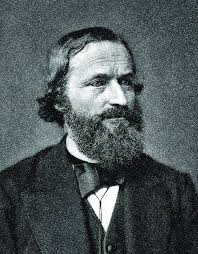
Kirchhoff was born on 12 March 1824 in Königsberg, Prussia. He studied mathematics and physics under Carl Gustav Jacob Jacobi and Franz Ernst Neumann, formulating his famous circuit laws in 1845 as part of his doctoral work—well before he held his first professorship.
In network analysis, Kirchhoff’s Current Law (KCL) states that the sum of currents entering a node equals the sum leaving it, ensuring conservation of charge:
\sum I_{\text{in}} = \sum I_{\text{out}}
Kirchhoff’s Voltage Law (KVL) asserts that the algebraic sum of voltages around any closed loop is zero, reflecting conservation of energy:
\sum V = 0
These laws extend Ohm’s law to multi-loop circuits and remain indispensable for troubleshooting and designing complex electrical systems.
Beyond electrical networks, Kirchhoff collaborated with Robert Bunsen to establish spectrum analysis, discovering the elements cesium and rubidium and formulating the law of thermal radiation. His work on black-body radiation laid the groundwork for quantum mechanics and transformed both physics and astronomy by revealing the composition of the Sun and stars.
His Contributions:
- Kirchhoff’s Current Law (KCL):
The algebraic sum of currents entering a node equals the sum leaving it.
\sum I_{\text{in}} = \sum I_{\text{out}}
This law ensures conservation of charge at junctions. - Kirchhoff’s Voltage Law (KVL):
The sum of all voltages around a closed loop equals zero.
\sum V = 0
This reflects conservation of energy in a circuit.
These laws allow electricians and engineers to break down complex circuits into solvable equations—whether you’re troubleshooting a marine panel or designing a multi-branch system.
Impact on Humanity:
Kirchhoff’s work extended into spectroscopy, helping identify elements in the sun and stars. He co-discovered cesium and rubidium, and laid the foundation for quantum mechanics through his study of black-body radiation.