

Relays let you use a small control signal to switch high-current loads safely and reliably. In marine electrical systems—where space is tight, moisture is everywhere, and circuits must be rock-solid—relays are everywhere: bilge pumps, navigation lights, motor controls, alarm systems, and more. Let’s break down what a relay is, how it works, the main types you’ll encounter, and how to wire them up correctly.
- What Is a Relay?
A relay is an electrically operated switch that isolates a low-current control circuit from a high-current load circuit.
- Coil side (control): energizes a magnetic coil with a small voltage (e.g., 12 VDC).
- Contact side (load): the mechanical switch that opens or closes under magnetic force.
- Isolation: no direct electrical connection between coil and contacts—ideal for protecting sensitive electronics.
- How a Relay Works
- Coil Energized
- Apply control voltage across the coil terminals.
- Current creates a magnetic field around the coil’s iron core.
- Magnetic Attraction
- The magnetic field pulls in the armature (a movable iron lever).
- Contact Switching
- Armature movement closes or opens the load-side contacts (NO/NC).
- Coil De-energized
- Spring returns the armature to its rest position, restoring original contact state.
ASCII Diagram of Basic Electromechanical Relay:
- Contact Terms
- COM (Common): the moving contact that toggles between NO and NC.
- NO (Normally Open): open when coil is off; closes when coil energizes.
- NC (Normally Closed): closed when coil is off; opens when coil energizes.
- Poles & Throws: define how many circuits a relay can switch and how many positions per circuit (see next section).
- Contact Configurations (Poles & Throws)
- Main Types of Relays
- Electromechanical Relay (EMR)
- Standard coil and moving contacts.
- Visible “click”; subject to wear and contact arcing.
- Solid-State Relay (SSR)
- Uses opto-couplers and semiconductor switches.
- No moving parts, silent, faster switching; requires heat sinking.
- Reed Relay
- Two ferrous blades sealed in inert gas.
- Very low contact resistance; limited current capacity.
- Latching Relay
- Mechanical or magnetic latch holds contact state after coil de-energizes.
- Ideal for battery-saving applications (e.g., remote panels).
- Time-Delay Relay
- Built-in timer delays switching after coil power-up or power-down.
- Useful for staged engine pre-heat or bilge pump delay.
- Wiring Diagrams & Connection Types
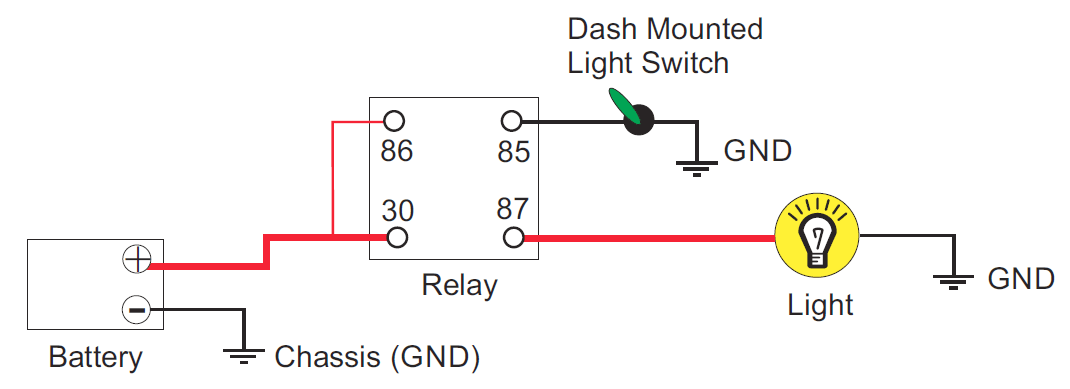
4-Pin SPST Relay (NO)
Use when you only need simple on/off control.
5-Pin SPDT Relay (Changeover)
Use when you need a default circuit (NC) and an alternate circuit (NO).
Connection Tips for Marine Use
- Choose sealed, IP67-rated relays to withstand salt spray.
- Mount vertically to avoid moisture pooling.
- Use tinned copper wire and heat-shrink or marine-grade bootlace ferrules.
- Label coil (85/86) and contacts (30/87/87a) clearly on your panel drawing.
- Recommended Next Steps
- Practice wiring SPST and SPDT relays on a bench panel.
- Build a simple control circuit: switch → relay coil → indicator light.
- Diagram your work and include terminals, wire gauges, and fuse locations.
- How a Relay Works
- Energized Coil: When voltage is applied to the coil, it creates a magnetic field.
- Magnetic Attraction: This field pulls the armature, changing the position of the contacts.
- Switching: The contacts either close (connect) or open (disconnect) the load circuit.
- De-energized Coil: When the coil loses power, the spring returns the armature to its original position.
This allows you to control high-current devices like pumps, lights, or motors using low-current control signals—perfect for marine panels and automation.
Types of Relays and Their Functions
| Relay Type | Description | Common Use | Contact Configuration |
|---|---|---|---|
| SPST (Single Pole Single Throw) | Basic on/off switch | Simple lighting or alarms | 1 NO or NC contact |
| SPDT (Single Pole Double Throw) | Switches between two outputs | Toggle circuits, failover systems | 1 NO + 1 NC contact |
| DPST (Double Pole Single Throw) | Controls two circuits simultaneously | Dual lighting or motor control | 2 NO or NC contacts |
| DPDT (Double Pole Double Throw) | Switches two circuits between two outputs | Reversing motors, complex logic | 2 NO + 2 NC contacts |
| Latching Relay | Maintains state after power loss | Battery-saving systems | Mechanical or magnetic latch |
| Solid-State Relay (SSR) | No moving parts, faster switching | Sensitive electronics, silent operation | Opto-isolated switching |
| Time Delay Relay | Switches after a preset time | Bilge pump delay, lighting fade | Adjustable timing circuit |
Wiring and Connection Tips
🛠️ Common Relay Terminals:
- 85 & 86: Coil terminals (control side)
- 30: Common terminal (connected to load)
- 87: Normally Open (NO)
- 87a: Normally Closed (NC)
Absolutely, Alexander! Here’s a comprehensive, apprentice-friendly blog post draft you can use to kick off your educational series. It explains how relays work, outlines the main types, and includes diagrams and connection tips tailored for marine and general electrical applications.
⚡ Understanding Relays: A Beginner’s Guide for Apprentice Electricians
Relays are one of the most fundamental components in electrical systems—especially in marine environments where space, safety, and reliability matter. If you’re just starting out, understanding how relays work will unlock a whole new level of control and protection in your circuits.
🧠 What Is a Relay?
A relay is an electrically operated switch. It allows a low-power signal to control a high-power circuit—without direct contact between the two. Think of it as a remote-controlled gate: when the control side (coil) is energized, it opens or closes the gate (contacts) on the load side.
🔧 Basic Components:
- Coil: Receives the control voltage.
- Armature: A movable part that responds to the magnetic field.
- Contacts: The switching elements—can be Normally Open (NO), Normally Closed (NC), or Common (COM).
- Spring: Returns the armature to its default position when de-energized.
⚙️ How a Relay Works
- Energized Coil: When voltage is applied to the coil, it creates a magnetic field.
- Magnetic Attraction: This field pulls the armature, changing the position of the contacts.
- Switching: The contacts either close (connect) or open (disconnect) the load circuit.
- De-energized Coil: When the coil loses power, the spring returns the armature to its original position.
This allows you to control high-current devices like pumps, lights, or motors using low-current control signals—perfect for marine panels and automation.
🧩 Types of Relays and Their Functions
| Relay Type | Description | Common Use | Contact Configuration |
|---|---|---|---|
| SPST (Single Pole Single Throw) | Basic on/off switch | Simple lighting or alarms | 1 NO or NC contact |
| SPDT (Single Pole Double Throw) | Switches between two outputs | Toggle circuits, failover systems | 1 NO + 1 NC contact |
| DPST (Double Pole Single Throw) | Controls two circuits simultaneously | Dual lighting or motor control | 2 NO or NC contacts |
| DPDT (Double Pole Double Throw) | Switches two circuits between two outputs | Reversing motors, complex logic | 2 NO + 2 NC contacts |
| Latching Relay | Maintains state after power loss | Battery-saving systems | Mechanical or magnetic latch |
| Solid-State Relay (SSR) | No moving parts, faster switching | Sensitive electronics, silent operation | Opto-isolated switching |
| Time Delay Relay | Switches after a preset time | Bilge pump delay, lighting fade | Adjustable timing circuit |
Source: Veris Industries
🔌 Wiring and Connection Tips
🛠️ Common Relay Terminals:
- 85 & 86: Coil terminals (control side)
- 30: Common terminal (connected to load)
- 87: Normally Open (NO)
- 87a: Normally Closed (NC)
🧰 Example Wiring Diagram: SPDT Relay

Source: 12 Volt Planet
🛥️ Marine-Specific Tips
- Use sealed relays (IP67 or better) to prevent corrosion.
- Mount relays vertically to reduce moisture pooling.
- Label terminals clearly for apprentices and future troubleshooting.
- Include relays in your schematics and training cards for clarity.
🧠 Final Thought for Apprentices
Relays are more than just switches—they’re the brain behind automation and protection. Once you understand how they work, you’ll start seeing them everywhere: bilge systems, nav lights, engine controls, and more.