

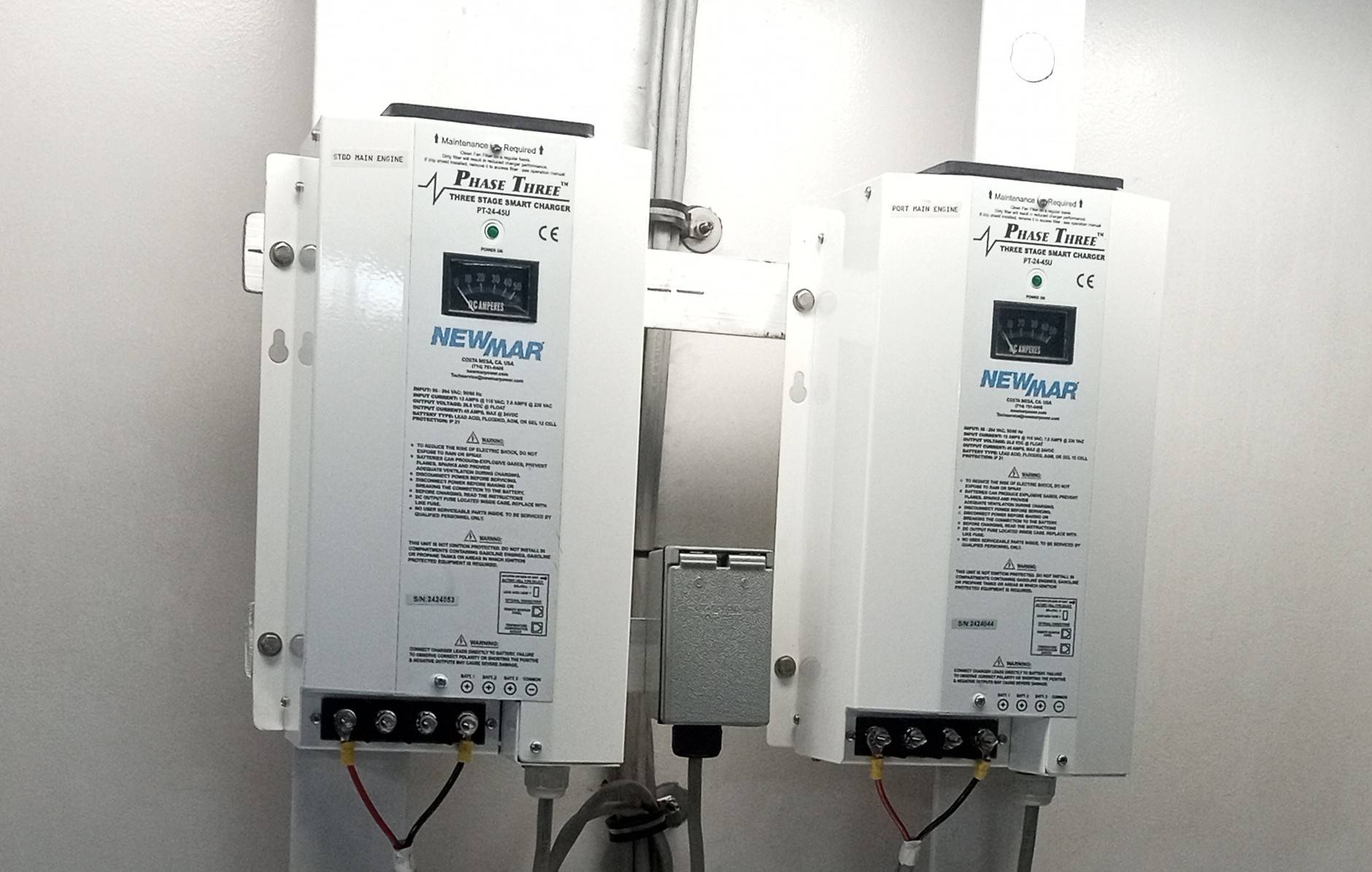
Inverters are essential for converting DC battery power into usable AC electricity on vessels. Whether you’re powering galley appliances, navigation gear, or emergency lighting, understanding how to wire an inverter system safely and effectively is a must.
Shipboard Inverter System Wiring Guide
For Apprentice Marine Electricians
Inverters are essential for converting DC battery power into usable AC electricity on vessels. Whether you’re powering galley appliances, navigation gear, or emergency lighting, understanding how to wire an inverter system safely and effectively is a must.
System Overview
Here’s what we’re connecting:
- Inverter: Converts 24V DC to 120V AC
- Main Power Panel: Distributes AC power from shore, genset, or inverter
- 120V Subpanel: Feeds branch AC circuits (lights, outlets, appliances)
- 24V DC Panel: Distributes DC power to pumps, radios, nav lights
- Battery Bank: Stores DC energy
- Battery Charger: Converts AC to DC to recharge batteries
- Relay: Automates switching between shore/genset and inverter
Wiring Diagram Overview
⚙️ Step-by-Step Wiring Breakdown
- Battery Bank → Inverter (DC Input)
- Use marine-grade tinned copper cable (AWG 2–0 depending on inverter size)
- Fuse the positive cable near the battery (Class T or ANL fuse)
- Connect negative cable to common ground bus
- Inverter → Main AC Panel (AC Output)
- Use 3-conductor marine AC cable (hot, neutral, ground)
- Connect inverter output to a dedicated breaker in the main panel
- Label clearly: “INVERTER FEED – DO NOT BACKFEED”
[Inverter AC Out] ──▶ [Breaker] ──▶ [Main AC Panel Bus]
- Shore Power → Main AC Panel
- Shore inlet connects to main panel via ELCI breaker
- Use transfer switch or relay to prevent backfeeding inverter
[Shore Inlet] ──▶ [ELCI Breaker] ──▶ [Transfer Switch] ──▶ [Main Panel]
- Main Panel → Battery Charger
- Charger converts AC to DC to recharge batteries
- Connect charger output to battery bank with fuse protection
- Include temperature sensor for smart charging
- Main Panel → 120V Subpanel
- Subpanel fed via double-pole breaker
- Neutral and ground separated (no bonding in subpanel)
- Use for outlets, lighting, small appliances
[Main Panel] ──▶ [Breaker] ──▶ [120V Subpanel]
- Battery Bank → 24V DC Panel
- DC panel feeds nav lights, pumps, radios
- Fuse each branch circuit individually
- Include voltmeter and ammeter for monitoring
- Relay Logic (AC Source Selection)
Use a relay or automatic transfer switch to select between shore power and inverter:
- Relay coil energized by shore power
- When shore is present, relay connects shore to panel
- When shore is absent, relay defaults to inverter
🛠️ Apprentice Tips
- Always fuse close to the power source
- Use color-coded labels and terminal strips
- Test polarity and voltage before energizing
- Ground inverter and charger per ABYC standards
- Never bond neutral and ground in subpanels
- 📘 Apprentice Challenge
- Draw your own inverter system diagram with:
- Battery bank
- Charger
- Inverter
- Relay
- AC and DC panels
Label wire gauges, fuse ratings, and breaker sizes. Then explain how the relay protects against backfeed and ensures safe source switching. - Training Card: Shipboard Inverter System Wiring
- 🔋 DC Side Overview
- Battery Bank → Inverter → 24V DC Panel
- Battery Bank
- 24V configuration (2x12V in series or 4x6V)
- Fuse on positive lead (Class T or ANL)
- Ground to common bus
- Inverter DC Input
- Heavy gauge cable (AWG 2/0 or per spec)
- Short run preferred
- Ventilated mounting location
- 24V DC Panel
- Individual fuses per circuit
- Volt/Amp meters for monitoring
- Common ground bus
- ⚡ AC Side Overview
- Shore Power / Inverter → Main Panel → Subpanel / Charger
- Shore Power Inlet
- ELCI breaker
- Connects to relay or transfer switch
- Inverter AC Output
- Routed to main panel via dedicated breaker
- Clearly labeled: “INVERTER FEED”
- Main AC Panel
- Breakers for charger, subpanel, outlets
- Neutral/ground bonded here only
- 120V Subpanel
- Separate neutral and ground
- Feeds branch AC loads
- Battery Charger
- AC input from panel
- DC output to battery bank
- Temp sensor recommended
- 🔁 Relay Logic
- Automatic Source Switching
- Relay Coil powered by shore AC
- Normally Open: connects shore to panel
- Normally Closed: defaults to inverter when shore is absent
- Prevents backfeed and protects inverter
- 🧠 Apprentice Notes
- Use marine-grade wire and terminals
- Label everything clearly
- Test polarity and voltage before energizing
- Follow ABYC grounding and bonding standards
- Never bond neutral and ground in subpanels
- 📊 Infographic Layout (Visual Concept)
- I’ll design this with:
- Left side: DC flow (Battery → Inverter → DC Panel)
- Right side: AC flow (Shore/Inverter → Main Panel → Subpanel/Charger)
- Center: Relay logic with switching arrows
- Color-coded paths: Red for DC, Blue for AC, Green for Ground
- Icons: Batteries, inverter, panels, relay, charger