

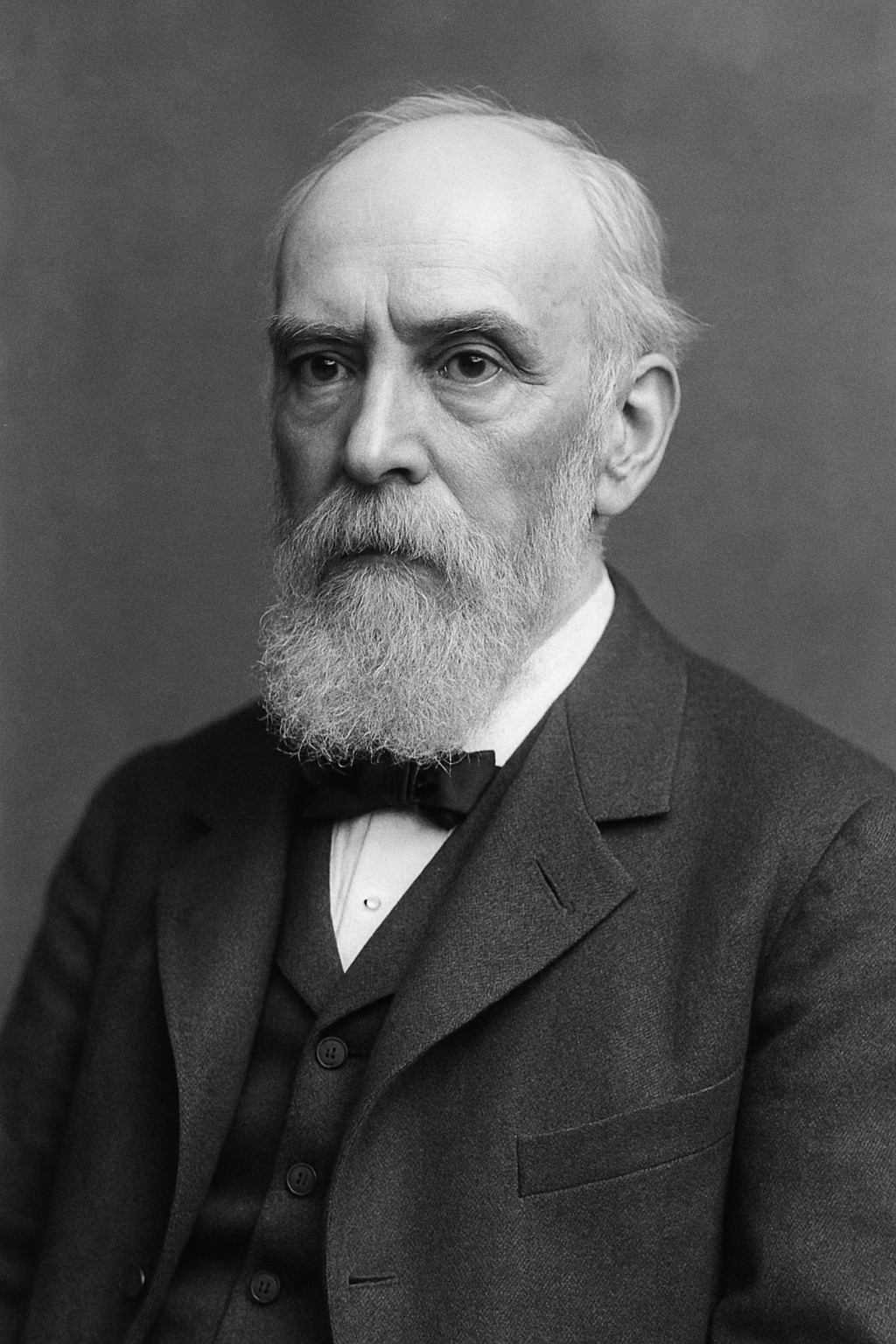
Early Life and Education
John Ambrose Fleming was born on November 29, 1849, in Lancaster, England, the eldest of seven children in a devout Christian family. His father, James Fleming, was a Congregational minister, and his mother, Mary Ann, nurtured his early love for science and books. As a boy, Fleming was fascinated by electricity long before it was widely understood. He would often dismantle clocks and build small electrical devices, showing an instinctive curiosity about how things worked.
At age 14, he built a simple electric motor powered by homemade batteries—a rare achievement for a teenager in the 1860s. This passion carried him into higher education. He studied at University College London (UCL), where he excelled in mathematics and physics. Later, he became one of the early students of the great Scottish physicist James Clerk Maxwell at Cambridge. Maxwell’s equations for electromagnetism (the now-famous set of four equations that describe how electric and magnetic fields interact) left a deep impression on him and influenced much of his later research.
Groundbreaking Research in Electricity
Fleming’s career blossomed during a time when electricity was moving from a curiosity to a practical technology. He worked as a consultant for companies like the Edison Electric Light Company in London, helping install some of the first electric lighting systems in Britain. His ability to bridge theoretical physics with practical engineering set him apart.
One of his most important contributions came in 1899, when Marconi hired him as a scientific advisor for his pioneering wireless telegraphy experiments. Wireless communication at the time was plagued by weak signals and poor reception. Fleming saw the problem clearly: the detectors used for radio waves were unreliable.
In 1904, he invented the thermionic valve (later called the vacuum tube diode). This was the world’s first true electronic device. It allowed current to pass in only one direction—rectifying alternating current (AC) into direct current (DC)—and could detect faint radio signals with far greater reliability than previous methods.
Mathematically, this was a breakthrough in understanding current flow. Fleming explained it using Ohm’s Law (V = IR) and extended it to the new field of thermionic emission, describing how electrons emitted from a heated cathode could be controlled inside a vacuum. This simple two-electrode device became the foundation of electronics, paving the way for amplification, radio broadcasting, and, eventually, the computer age.
Challenges as a Man in Science
Despite his brilliance, Fleming faced challenges. In late Victorian England, the boundaries between pure science and engineering were rigid. Many physicists looked down on practical engineers, while industrialists were suspicious of academics. Fleming, who straddled both worlds, often found himself defending his credibility.
He also faced legal battles. In the United States, Lee de Forest patented the triode (an improved vacuum tube with three elements), and disputes over priority strained relations between inventors. Fleming felt frustrated that his original diode invention was sometimes overshadowed, even though it was the essential first step.
Another personal challenge was financial. Though he worked as a consultant, his university salary was modest, and he often depended on side work in industry. Yet he never abandoned his dedication to teaching. At UCL, students recalled his fiery lectures—his eyes “glowed with passion” when he described the invisible dance of electrons.
Dedication and Anecdotes
Fleming’s devotion to his work was legendary. He was known for his motto, “The right thing must be done in the right way.” His students affectionately called him “the Professor with the Spark.”
One famous anecdote recalls how, during his experiments with Marconi’s wireless signals, he worked through the night in a freezing laboratory. When the first faint signals were detected clearly thanks to his diode, he reportedly whispered, “We are listening to the future.”
Even in his seventies, he continued experimenting, sketching circuit diagrams by candlelight. He was also deeply religious, writing books that sought harmony between science and faith. For him, the mysteries of electricity and the order of mathematics revealed the fingerprints of a Creator.
Lasting Legacy
Fleming retired from UCL in 1926, but by then his invention had already changed the world. The vacuum tube diode and its successors powered radios, telephones, radar, and the first digital computers. The ENIAC, one of the earliest general-purpose computers, relied on thousands of vacuum tubes—each a descendant of Fleming’s 1904 diode.
He was knighted in 1929, becoming Sir John Ambrose Fleming, in recognition of his service to science and engineering. He continued to write and lecture well into old age.
Fleming died on April 18, 1945, at the age of 95. By then, the world was on the brink of the transistor age, but none of it would have been possible without his pioneering work.
Posthumous Recognition and Impact
Today, Fleming is remembered as the Father of Modern Electronics. His thermionic valve was the spark that ignited the electronic revolution. Every electrician who handles rectifiers, amplifiers, or even the modern silicon diode owes a debt to his work.
The “Right-Hand Rule,” still taught to electricians to determine the direction of current, magnetic field, and force, is attributed to him and remains a practical tool in the trade. His equations and diagrams continue to appear in textbooks.
More broadly, Fleming’s story is one of vision and perseverance. He bridged theory and practice, faith and science, classroom and workshop. For electricians, his life reminds us that every circuit we wire and every system we maintain connects to a legacy of discovery that changed the world.
✅ Inspiration for Electricians: Fleming proved that dedication to both the practical and the theoretical can light the way to progress. His invention took invisible waves and turned them into voices, music, and data—laying the groundwork for the electrical world we live in today.
John Ambrose Fleming: The Father of Modern Electronics
(expanded version with illustrations and annotated equations)
Key Invention: The Thermionic Valve (1904)
The thermionic valve (vacuum tube diode) was Fleming’s great breakthrough.
How it works (step by step):
- A cathode (metal filament) is heated → electrons “boil off” due to thermionic emission.
- A plate (anode) is placed nearby → if it is positively charged, electrons flow across the vacuum.
- If the plate is negative → no electrons flow.
- This creates a one-way electrical valve: current flows in only one direction.
This was the world’s first rectifier—able to turn AC into DC and detect faint radio signals.
Practical Equation Breakdown
Fleming’s diode behavior can be explained with basic electrical laws familiar to electricians:
- Ohm’s Law:
V=I⋅RV = I \cdot RV=I⋅R
- Voltage (V) drives the current (I) through resistance (R).
- Thermionic Emission (Richardson–Dushman Equation):
J=AT2e−WkTJ = A T^2 e^{-\frac{W}{kT}}J=AT2e−kTW
- J = current density (amps per square meter)
- A = Richardson constant
- T = filament temperature (Kelvin)
- W = work function (energy needed for electrons to escape metal)
- k = Boltzmann’s constant
➡ This formula showed that heating the filament releases electrons, a concept every modern rectifier and electron tube relies on.
- Rectification Principle:
When connected to AC:
- Positive half-cycle → current flows (electrons move from cathode to anode).
- Negative half-cycle → current blocked.
I(t)=I0⋅sin(ωt)for sin(ωt)>0I(t) = I_{0} \cdot \sin(\omega t) \quad \text{for } \sin(\omega t) > 0I(t)=I0⋅sin(ωt)for sin(ωt)>0
- The diode clips the negative half of the AC sine wave → producing DC.
Simple Illustration (annotated)
Vacuum Tube Diode Schematic (simplified):
   (Anode / Plate +)
       |
       |    Electrons → → →
       |
   [Vacuum Space]
       |
   (Heated Cathode -)
       |
     Filament
➡ When the plate is positive, electrons flow across the vacuum.
➡ When it’s negative, electrons are blocked → one-way valve for electricity.
Anecdote from His Experiments
When Fleming first tested his valve, he connected it to Marconi’s wireless receiver. Suddenly, the weak, crackling dots and dashes of Morse code came through loud and clear. He famously said:
“It is as if we have given ears to the ether.”
For electricians, this meant the dawn of reliable signal detection—the same principle behind your modern rectifiers and radio circuits.
Legacy in the Electrician’s World
- Rectifiers in power supplies (the heart of every charger, welder, and amplifier) → trace back to Fleming’s diode.
- Amplification & broadcasting → vacuum tubes expanded his invention.
- Right-Hand Rule → still used today in wiring and motors, developed by Fleming.
✅ Takeaway for Electricians:
Fleming gave us the first electronic valve. His diode turned alternating chaos into direct order, laying the foundation for everything from radios to computers. Every rectifier, every DC supply, and every amplifier owes its existence to that glowing little filament in 1904.
John Ambrose Fleming is best remembered for his guiding motto:
“The right thing must be done in the right way.”
This phrase reflected both his scientific discipline and his moral philosophy, and it became his personal rule for life and work.