

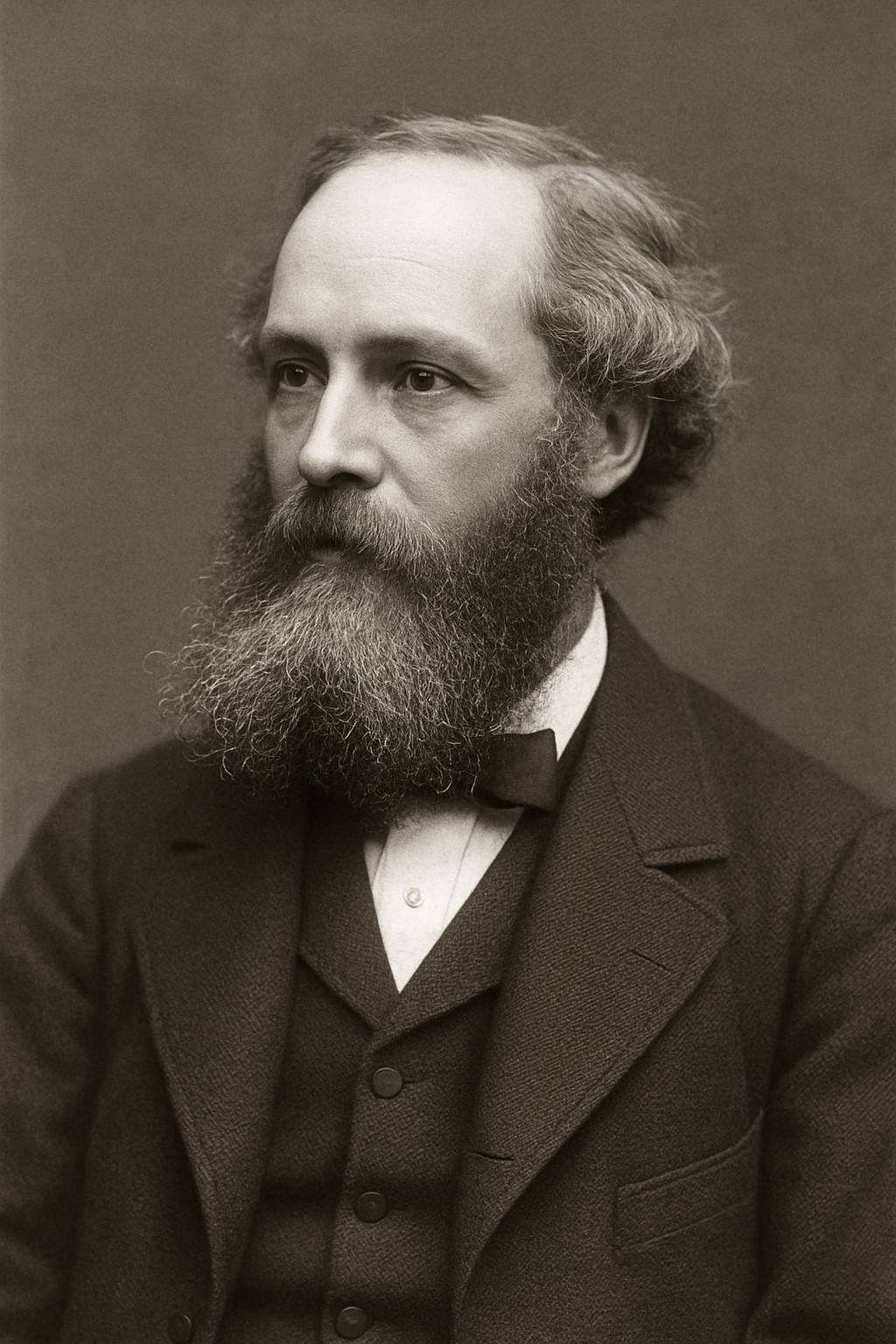
Early Life and Education
James Clerk Maxwell was born on June 13, 1831, in Edinburgh, Scotland. His father, John Clerk Maxwell, was a lawyer and landowner, while his mother, Frances Cay Maxwell, was an intelligent woman who encouraged his curiosity. From a young age, James displayed an extraordinary fascination with the patterns and structures of the natural world.
At just 14 years old, he published his first scientific paper on oval curves—an early sign of his remarkable mathematical talent. He studied at the University of Edinburgh and later at Cambridge University, where he became a top scholar. Those who knew him described him as shy, deeply religious, and humble, but with a brilliant mind that constantly sought connections between nature’s forces.
Groundbreaking Research in Electricity and Magnetism
In the mid-19th century, electricity and magnetism were studied separately. Experimenters like Michael Faraday had shown that a changing magnetic field could induce current, but the mathematics to unify electricity and magnetism was missing. Maxwell provided that unification.
Between 1861 and 1862, Maxwell published his four famous equations, now called Maxwell’s Equations, which brought together electricity, magnetism, and light into a single framework.
Maxwell’s Equations (Simplified for Electricians)
- Gauss’s Law for Electricity
∇⋅E=ϵ0ρ
Electric charges create electric fields.
- Gauss’s Law for Magnetism
∇⋅B=0
There are no magnetic charges (no isolated north or south pole).
- Faraday’s Law of Induction
∇×E=−∂t∂B
A changing magnetic field produces an electric field (the principle behind transformers and generators).
- Ampère–Maxwell Law
∇×B=μ0J+μ0ϵ0∂t∂E
A current—or a changing electric field—creates a magnetic field.
The Wave of Light
Maxwell realized these four equations predicted the existence of electromagnetic waves. He calculated their speed and found it matched the measured speed of light.

This stunning discovery showed that light itself is an electromagnetic wave. For electricians, this meant that the same principles guiding motors and generators also explained sunlight and radio waves. Maxwell’s insight laid the foundation for wireless communication, radar, and modern electronics.
Challenges as a Man in Science
Maxwell’s genius wasn’t always recognized in his lifetime. Many physicists of his day found his equations too abstract. Experimentalists preferred hands-on demonstrations, while mathematicians thought he was too physical in his approach.
He also struggled personally. His mother died when he was eight, leaving him in the care of tutors who didn’t always understand his brilliance. Later in life, he battled poor health, and despite his accomplishments, he never enjoyed the fame of contemporaries like Faraday.
Still, he remained devoted to his work and to teaching. As a professor at King’s College London, his students remembered his kindness and humility, even as he explained some of the most difficult ideas in physics.
Anecdotes of Dedication
- The Color Wheel: Maxwell was one of the first to scientifically study color vision. In 1861, he created the world’s first color photograph using red, green, and blue filters—an invention that would eventually lead to color TV and digital screens.
- The Friendly Farmer: On his family estate in Scotland, Maxwell often worked alongside farmhands, building models and explaining natural phenomena. They remembered him as the “gentleman who turned light into equations.”
- Late Nights with Equations: When struggling to unify electricity and magnetism, Maxwell often worked late into the night, covering his desk with sketches of lines of force—translating Faraday’s intuitive field concepts into precise mathematics.
Lasting Legacy
Maxwell’s unification of electricity, magnetism, and light is considered one of the greatest achievements in science. Albert Einstein later said:
“The work of James Clerk Maxwell changed the world forever. When I discovered Maxwell’s equations, I knew I had found the most profound thing since Newton.”
For electricians:
- Motors and Generators → Directly rely on Faraday’s Law, formalized by Maxwell.
- Transformers → Operate because of Maxwell’s description of induction.
- Wireless Communication → Possible because Maxwell showed that light and radio are electromagnetic waves.
- Modern Electronics → From rectifiers to antennas, all trace back to his unified theory.
Death and Posthumous Recognition
Maxwell died on November 5, 1879, at the age of 48, from stomach cancer—the same age at which his mother had died. Though his life was short, his influence was vast.
Today, he is honored as one of the greatest physicists of all time, ranked alongside Newton and Einstein. Statues, institutes, and memorials bear his name, including the Maxwell Institute for Mathematical Sciences in Edinburgh.
Inspiration for Electricians
Maxwell’s story is not just about mathematics—it’s about vision. He saw unity where others saw fragments. He proved that the sparks in a wire, the fields around a magnet, and the sunlight streaming from the sky were all part of the same grand phenomenon.
✅ For every electrician wiring a motor, testing a transformer, or installing a radio antenna, the invisible laws Maxwell uncovered more than 150 years ago are still at work. His equations are not just theory—they are the heartbeat of the modern electrical world.
James Clerk Maxwell’s most famous quote is:
“Thoroughly conscious ignorance is the prelude to every real advance in science.”
This reflects his belief that progress begins when we recognize the limits of our knowledge—and push beyond them.