

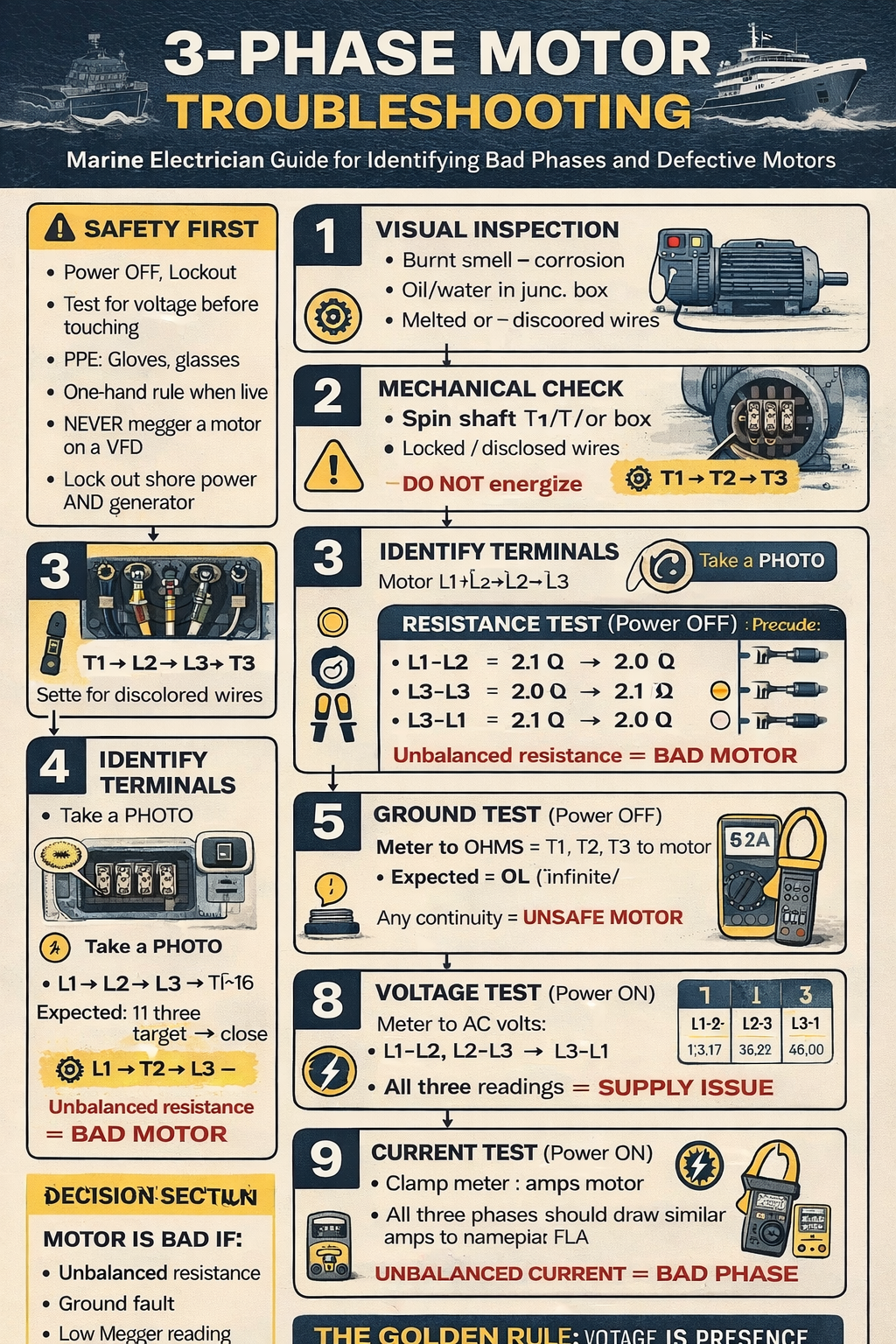
This will cover:
- How a 3-phase motor works (very simply)
- Safety and tools
- Step-by-step troubleshooting process
- How to tell if one phase is bad
- How to tell if the motor is bad vs supply problem
- Common marine failures
- Clear pass/fail rules
1️⃣ First: Understand a 3-Phase Motor (Plain English)
A 3-phase motor needs THREE equal power legs (L1, L2, L3).
Think of it like rowing a boat:
- 3 people rowing evenly → smooth motion
- 1 person stops → motor hums, overheats, or stalls
- 1 person weak → motor runs but overheats and pulls high amps
If any phase is missing or weak, the motor is in danger.
2️⃣ Tools You MUST Have (Marine Minimum)
✅ Digital multimeter (AC volts, ohms)
✅ Clamp ammeter (VERY important for phase comparison)
✅ Insulation resistance tester (Megger)
✅ PPE (gloves, glasses)
✅ Lockout/Tagout
✅ Flashlight & camera
✅ Contact cleaner (marine corrosion)
Optional but excellent:
- Phase rotation meter
- Infrared thermometer
3️⃣ SAFETY — Marine-Specific Rules
⚠️ Never trust shore power or generators blindly
⚠️ Salt + moisture = insulation failure
⚠️ Always test before touching
⚠️ Lockout generator + shore power
⚠️ One-hand rule when live testing
⚠️ Never megger a motor connected to a VFD
4️⃣ The CORRECT Troubleshooting Order (DO NOT SKIP STEPS)
Always follow this order
- Visual inspection
- Mechanical check
- Electrical tests (power OFF)
- Insulation test (megger)
- Live voltage test
- Live current (amp) test
- Conclusion
Skipping steps = wrong diagnosis.
5️⃣ STEP 1 — Visual Inspection (Power OFF)
Look for:
- Burnt smell → overheated windings
- Discolored terminals → loose connection
- Salt buildup / corrosion
- Oil or water inside junction box
- Melted insulation
- Loose lugs (VERY common on boats)
🚩 If you see melted or blackened windings → motor is bad
6️⃣ STEP 2 — Mechanical Check (Power OFF)
- Turn shaft by hand
- Smooth → good
- Grinding → bearing failure
- Locked → seized motor or driven load
- Disconnect load if possible (pump, compressor, gearbox)
- A bad load can make a good motor look bad
🚩 Locked rotor = DO NOT energize
7️⃣ STEP 3 — Identify Motor Terminals
Most 3-phase motors:
- T1, T2, T3 (simple)
- Or T1–T6 (dual voltage)
- Or U, V, W
⚠️ Before disconnecting → TAKE A PHOTO
8️⃣ STEP 4 — Winding Resistance Test (Power OFF)
Purpose:
Check if windings are open or shorted
Procedure:
- Disconnect motor completely
- Set meter to OHMS
- Measure:
- L1–L2
- L2–L3
- L3–L1
Expected Results:
- All three readings should be very close
- Example:
- L1–L2 = 2.1 Ω
- L2–L3 = 2.0 Ω
- L3–L1 = 2.1 Ω
- Example:
BAD Results:
| Reading | Meaning |
|---|---|
| OL | Open winding → BAD motor |
| 0 Ω | Shorted winding → BAD motor |
| One reading very different | Winding damage |
🚩 If resistance is not balanced → motor is bad
9️⃣ STEP 5 — Ground Test (Power OFF)
Purpose:
Check insulation to frame (very important in marine)
Procedure:
- Meter to ohms
- Measure each phase to motor frame
- L1 → Frame
- L2 → Frame
- L3 → Frame
Expected:
- OL / infinite resistance
🚩 Any continuity = ground fault → motor is unsafe
🔟 STEP 6 — Insulation Resistance Test (Megger)
Marine Standard:
- Test at 500 VDC
- Test each phase to ground
Results:
| Megger Reading | Condition |
|---|---|
| >100 MΩ | Excellent |
| 10–100 MΩ | Acceptable |
| 1–10 MΩ | Marginal |
| <1 MΩ | FAIL (replace or rewind) |
🚩 Salt contamination often shows here first
1️⃣1️⃣ STEP 7 — Live Voltage Test (Power ON)
Purpose:
Check if supply phases are good
Procedure:
Meter to AC volts:
- L1–L2
- L2–L3
- L3–L1
Expected:
- All readings within ±2–3%
Example (480 V motor):
- 479 V
- 482 V
- 478 V → GOOD
🚩 If one leg is low or missing → SUPPLY problem, not motor
1️⃣2️⃣ STEP 8 — Live Current (Amp) Test (MOST IMPORTANT)
This tells the truth.
- Clamp meter on:
- L1
- L2
- L3
- Compare readings to each other and nameplate FLA
Expected:
- All three currents within ±10%
Example GOOD:
- L1 = 18.2 A
- L2 = 18.5 A
- L3 = 17.9 A
Example BAD (Single Phasing):
- L1 = 30 A
- L2 = 5 A
- L3 = 28 A
🚩 Unbalanced current = missing or weak phase
1️⃣3️⃣ How to Tell IF ONE PHASE IS BAD
Symptoms of a Bad Phase:
- Motor hums
- Motor overheats quickly
- One leg high amps, one leg low
- Trips overload
- Shaft difficult to start
Diagnosis Table:
| Symptom | Cause |
|---|---|
| Low voltage on one leg | Supply issue |
| Zero amps on one leg | Open phase |
| High amps on two legs | Single phasing |
| Motor runs but hot | Weak phase |
1️⃣4️⃣ Marine-Specific Common Failures
| Issue | Cause |
|---|---|
| Corrosion at terminals | Salt air |
| High resistance connections | Vibration |
| Low insulation resistance | Moisture |
| Generator imbalance | AVR or winding issue |
| Overheating | Poor ventilation |
1️⃣5️⃣ FINAL DECISION CHART
Motor is BAD if:
✔ Resistance unbalanced
✔ Short to ground
✔ Megger <1 MΩ
✔ Burnt windings
✔ Locked rotor
Supply is BAD if:
✔ Voltage imbalance
✔ One phase missing
✔ Generator issue
✔ Contactor/fuse blown
1️⃣6️⃣ GOLDEN RULE (Marine Electricians)
Voltage tells you if power is present
Resistance tells you if windings are intact
Current tells you the TRUTH
“Explain delta vs wye”
Absolutely — this is core knowledge for a Marine Electrician. I’ll explain Delta vs Wye step by step, from zero, with marine and generator context, and show you how to identify, wire, and troubleshoot each.
🔺 DELTA vs ⭐ WYE (STAR) — Explained Simply
Big Picture First
A 3-phase motor has three windings.
Delta and Wye describe how those windings are connected together.
Think of the windings like ropes tied together in different shapes.
⭐ WYE (STAR) CONNECTION
How it’s wired
- One end of each winding is tied together at a common point (neutral)
- The other three ends go to L1, L2, L3
        L1
         |
        [W]
         |
          \
           \
            N  ← common point (star point)
           /
          /
        [W]
         |
        L2

        [W]
         |
        L3
Electrical Characteristics (VERY IMPORTANT)
| Item | WYE |
|---|---|
| Line Voltage (L-L) | Full voltage (e.g. 480 V) |
| Winding Voltage | Line ÷ √3 (480 ÷ 1.732 ≈ 277 V) |
| Starting Current | LOWER |
| Starting Torque | LOWER |
| Stress on windings | LOWER |
Where Wye is used (Marine context)
✅ High-voltage systems (480 V, 600 V)
✅ Large motors
✅ Long cable runs
✅ Generator-fed systems
✅ Reduced starting current situations
🚢 Most marine 480 V motors start in Wye
Pros / Cons
Pros
- Lower inrush current
- Less stress on insulation
- Easier on generators
Cons
- Lower starting torque
- Not ideal for heavy-load starts
🔺 DELTA CONNECTION
How it’s wired
- Windings are connected end-to-end in a closed loop
- Each junction goes to L1, L2, L3
        L1
         ●────[W]────● L2
          \           /
           \         /
            [W]     [W]
              \     /
               \   /
                 ●
                L3
Electrical Characteristics
| Item | DELTA |
|---|---|
| Line Voltage | Full voltage |
| Winding Voltage | Full voltage |
| Starting Current | HIGH |
| Starting Torque | HIGH |
| Stress on windings | HIGHER |
Where Delta is used (Marine context)
✅ Pumps
✅ Compressors
✅ Winches
✅ Bow thrusters
✅ High starting torque loads
⚠️ Can stress generators if started across-the-line
Pros / Cons
Pros
- High starting torque
- Full power
Cons
- High inrush current
- Harder on generators and cables
⚓ WYE–DELTA STARTING (Very Common on Ships)
Many marine motors use Wye–Delta starters.
How it works:
- Motor starts in Wye
- Low current
- Gentle on generator
- After a few seconds…
- Switches to Delta
- Full torque
- Full power
Why ships use this:
✔ Reduces voltage dip
✔ Prevents generator overload
✔ Smooth motor startup
🔧 How to IDENTIFY Delta vs Wye in the Field
1️⃣ Terminal Box Inspection
If motor has 6 terminals (T1–T6):
| Connection | Jumper Pattern |
|---|---|
| Wye | Three terminals tied together |
| Delta | Three jumpers forming a triangle |
2️⃣ Nameplate (ALWAYS CHECK)
Look for:
- Δ / Y symbols
- Voltage pairs (example):
- Δ 230 V / Y 400 V
- Δ 460 V / Y 800 V
3️⃣ Resistance Test (Power OFF)
- Measure winding resistances
- Balanced readings indicate healthy windings
- Wiring pattern tells Delta or Wye
⚠️ COMMON DELTA / WYE MISTAKES (Marine Failures)
🚩 Delta connected to Wye voltage → burnt motor
🚩 Wye connected to Delta voltage → won’t start
🚩 Incorrect jumpers → overcurrent
🚩 Generator undervoltage → single phasing
🧪 Troubleshooting Delta vs Wye Problems
Motor hums, won’t start
- Delta wired but supply too weak
- Generator sag
Motor overheats
- Delta load too heavy
- One phase missing
Trips overload
- Incorrect transition in Wye–Delta starter
- Timer misadjusted
🧠 Golden Marine Rule
Voltage tells you if power is present
Current tells you if the motor is happy
Connection (Delta/Wye) tells you if it will survive
