

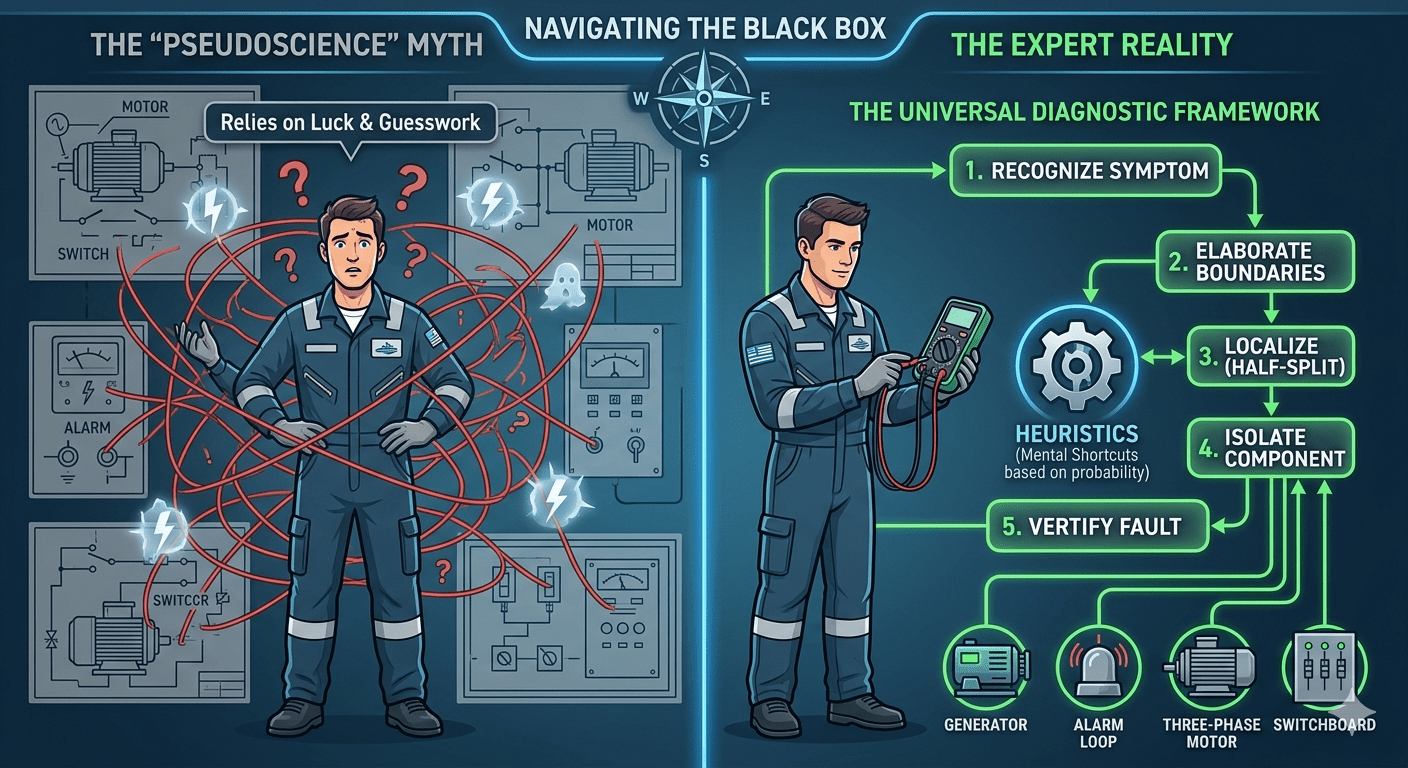
We are often viewed by the crew as wizards. When a complex system fails—a generator won’t sync, a fire loop trips falsely, or a 50 HP motor dead-shorts—we are expected to walk in, glance at the problem, and “just know” the fix.
Experienced techs often feel like they are using magic, but that feeling of “educated guessing” isn’t magic, and it’s certainly not “pseudoscience.” It’s a highly sophisticated form of abductive reasoning and heuristics.
You aren’t guessing. You are calculating probability faster than you realize.
The Myth of “Direct Knowledge”
The biggest misunderstanding about troubleshooting is that an expert should find the problem directly. In complex marine systems, which are subject to heat, extreme vibration, and salt ingress, the path to a solution is rarely a straight line.
If you try to troubleshoot a motor or a switchboard by strictly following a linear checklist (A \rightarrow B \rightarrow C), you will spend weeks testing components that are working perfectly.
Pseudoscience vs. Heuristics
- Pseudoscience is relying on belief, anecdotal success, or unproven claims (e.g., “Always whack Component X because it fixed it once”).
- Heuristics are mental shortcuts based on probability, history, and physics. When you look at a corroded terminal and instantly know the sensor is fine but the ground is floating, your brain has processed thousands of previous failures to reach that statistical conclusion in milliseconds.
Navigating the Black Box: The Diagnostic Framework
Because we cannot see electrons moving, modern electronics are effectively “Black Boxes.” Since you cannot observe the internal logic, you must rely on Input/Output testing.
The difference between a master and a novice isn’t that the master always makes the “correct” guess first. It’s that the master uses a Universal Diagnostic Framework (visualized above) to structure their guesses so they never waste time.
The Six-Step Systematic Method
This is the standard model I use for everything from an alarm loop to a generator AVR failure. It moves troubleshooting from an “art” to a “repeatable process.”
| Step | Core Action | Pro Tip for the Marine Environment |
|---|---|---|
| 1. Symptom Recognition | Define exactly what is failing. | Don’t just look at the fault light; check gauge pressure, temperature, and voltage balance simultaneously. |
| 2. Symptom Elaboration | Define the boundaries. | When does it fail? Cold start? Full load? Only when high ambient humidity? |
| 3. Localize the Fault | Use the Divide and Conquer approach. | The Half-Split method (testing at the 50% mark) eliminates half the circuit in one measurement. |
| 4. Isolate the Fault | Verify the lie with your meter. | Don’t trust a new part. If the output is bad but the inputs are good, the component itself is dead. |
| 5. Rectify | Fix it. | Repair or replace to OEM specifications. Never “hack” a patch in a marine system. |
| 6. Functional Verification | Test it under real conditions. | Cycle it through all modes. Load test the generator. Verify all alarm points. |
Mastering Your Equipment “Battle Plans”
While the logic is universal, your tools must be specialized:
- Switchboards: The enemies are heat and vibration. An IR camera finds a loose lug before it fails. Use the (careful) insulated “Tap Test” for intermittent contacts.
- Alarm Systems (DC Loops): Measure Voltage Drop. If you have proper voltage at the panel but low voltage at the End of Line (EOL), you have high resistance.
- Ground Faults: Use “Divide and Conquer.” Open the main breaker, if the fault clears, it’s downstream. Keep an eye out for non-standard configurations, where a wire might be utilized as a ground path even if it doesn’t match standard color coding. Always verify the path to the hull/earth.
- Motors & Transformers: Use a Megger. Multimeters cannot find a pinhole leak in winding insulation that only arcs at 480\text{V}. Check Phase Balance.
- Generators: Mechanical (Hz) or Electrical (V)? If Hz is wrong, it’s fuel/mechanical. If V is wrong, it’s AVR/excitation.
troubleshooting is not a random walk; it is a stochastic process—using randomness and statistical probability to solve a complex puzzle.
Keep calculating, colleagues. It’s what masters do.