

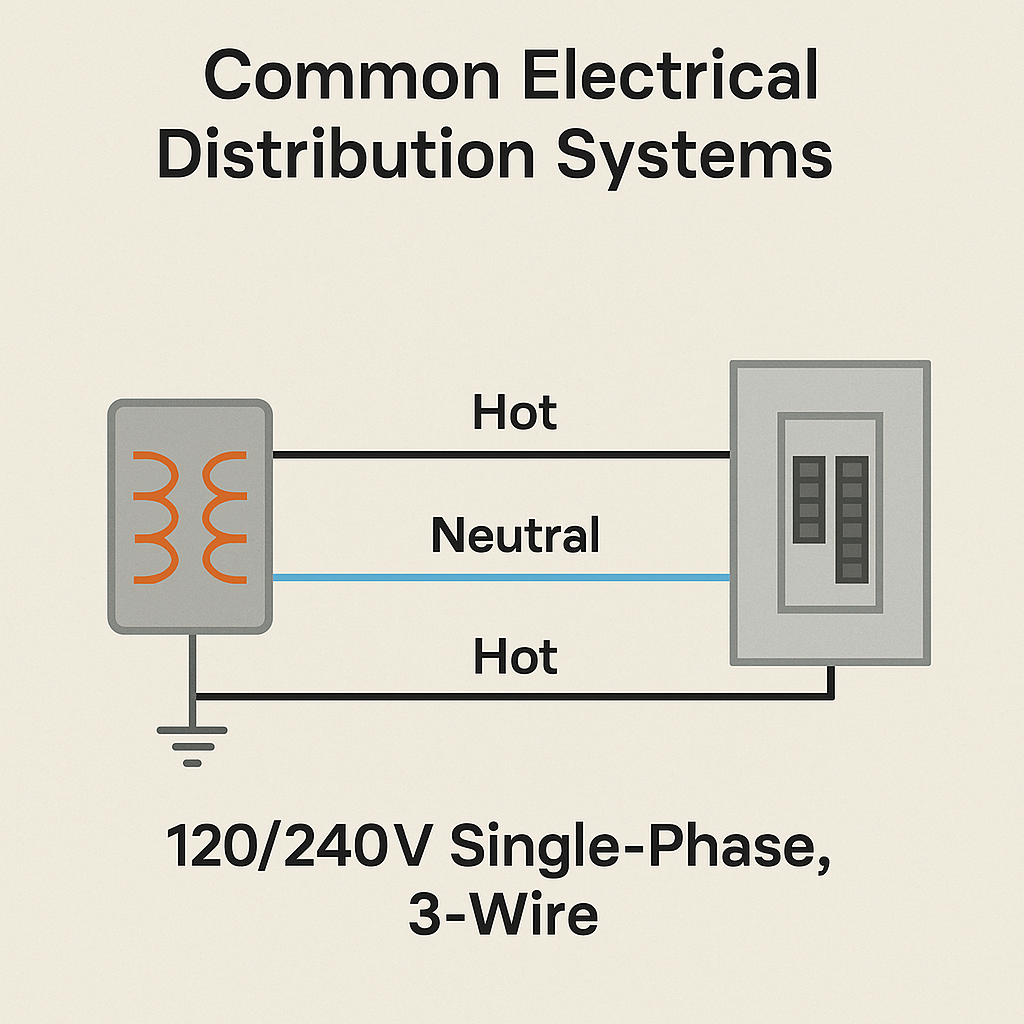
120V/240V single-phase three-wire distribution system is on its way ⚡. It’s a common residential setup in North America, ideal for splitting power between standard appliances and higher-load equipment. Let me know if you’d like a comparison with three-phase systems next!
How does 120V/240V single-phase compare to three-phase systems?
⚡ 120V/240V Single-Phase (Three-Wire Split Phase)
- Configuration: Two hot wires and one neutral from a center-tapped transformer.
- Voltages Available:
- 120V between each hot and neutral (for standard outlets).
- 240V between the two hot wires (for heavy appliances).
- Power Delivery: Pulsating—voltage drops to zero twice per cycle.
- Applications: Residential homes, small offices, light loads.
- Pros:
- Simple and cost-effective.
- Easy to install and maintain.
- Cons:
- Less efficient for high-power equipment.
- Voltage fluctuations can affect sensitive electronics.
🔁 Three-Phase Systems
- Configuration: Three hot wires (each 120° out of phase) and optionally a neutral.
- Voltages Available:
- Common setups include 208V, 240V, 480V depending on wiring (Wye or Delta).
- Power Delivery: Continuous and balanced—never drops to zero.
- Applications: Industrial facilities, commercial buildings, data centers.
- Pros:
- More efficient for motors and heavy machinery.
- Smoother operation and better load balancing.
- Transmits more power using less conductor material.
- Cons:
- More complex installation.
- Higher upfront cost.
🔍 Quick Comparison Table
| Feature | Single-Phase (120V/240V) | Three-Phase |
|---|---|---|
| 🔌 Wires | 2 hot + 1 neutral | 3 hot (+ optional neutral) |
| ⚡ Voltage Options | 120V / 240V | 208V / 240V / 480V |
| 🔄 Power Flow | Pulsating | Continuous |
| 🏠 Usage | Residential | Industrial / Commercial |
| ⚙️ Motor Efficiency | Lower | Higher |
| 💡 Load Balancing | Limited | Excellent |
Common electrical distribution systems 120/208 volt three phase four wire wye connected
120/208V three-phase four-wire Wye-connected distribution system graphic—fresh from the drawing board ⚡. It’s a popular configuration in commercial buildings, offering both 120V for standard outlets and 208V for heavier equipment.

common electrical distribution systems 277/480 volt three phase four wire wye connected.
277/480V three-phase four-wire Wye-connected distribution system is coming right up ⚡. It’s widely used in commercial and industrial settings, especially where lighting and motor loads are heavy.
🔧 System Overview
The 277/480V Wye system uses:
- Three phase conductors (A, B, C)
- One neutral conductor
- A Wye-configured transformer
Each phase is 120° apart in waveform, providing continuous and balanced power flow.
⚡ Voltage Breakdown
- Phase-to-neutral (line-to-neutral): 277V
Ideal for commercial lighting (e.g., fluorescent fixtures). - Phase-to-phase (line-to-line): 480V
Used for high-power equipment like motors, HVAC, and industrial machinery.
🏢 Common Applications
- High-rise buildings and large retail centers
- Warehouses, factories, and schools
- Facilities with mixed lighting and equipment loads
✅ Advantages
- Efficient power delivery for large loads
- Balanced voltage distribution
- Reduced current for same power, meaning smaller wires and less heat
- Compatible with 277V lighting systems, reducing transformer needs
. The Connection Layout
To connect the two, you will run a dedicated branch circuit from the panel to the water heater.
At the Panel: You must install a 3-pole circuit breaker. Because a water heater is considered a “continuous load,” the National Electrical Code (NEC) requires the breaker and wiring to be sized at 125% of the heater’s rated amperage.
The Conductors: You will run four wires total: three “hot” phases and one ground.
Phase A: Black
Phase B: Red
Phase C: Blue
Ground: Green or Bare Copper
Neutral (White): Most 3-phase water heaters are Delta-connected resistive loads and do not require a neutral wire. However, always check the manufacturer’s wiring diagram to see if a neutral is needed for internal 120V control circuits.
2. Sizing the Circuit (Example)
Since the wattage of water heaters varies, here is how you calculate the specific requirements for a common commercial 18kW unit:


3. Select Hardware: You would use a 70A 3-pole breaker and #4 AWG copper wire (rated for 70A–85A depending on insulation type).
| Connection Point | Component | Requirement |
|---|---|---|
| Source | 800A Main Panel | 3-Pole Breaker (Sized to Load) |
| Path | Conduit | EMT or Flexible Liquid-tight |
| Termination | Water Heater Junction Box | L1, L2, L3 + Ground Lug |
Critical Safety Checklist
- Verify Voltage: Ensure the water heater nameplate specifically says 208V. If the heater is rated for 240V, it will still work on a 208V circuit but will produce roughly 25% less heat (e.g., a 10kW heater becomes a 7.5kW heater).
- Local Disconnect: Code usually requires a visible “safety switch” or disconnect box within sight of the water heater so a technician can cut power locally.
- Dry Fire Warning: Never turn the breaker ON until the water tank is completely full of water, or you will burn out the heating elements in seconds.
- In electrical systems, a neutral wire is primarily used as a return path for current in 120V (single-phase) circuits or to carry the “unbalanced” current in 3-phase systems. Many high-power industrial and commercial machines do not require a neutral because they are designed as balanced loads.
- In these devices, the current flowing “in” through the hot phases perfectly cancels out, meaning there is no leftover current that needs to return via a neutral wire.
- 1. 3-Phase Industrial Equipment
- Most heavy-duty 3-phase equipment uses a Delta (\Delta) connection, which inherently has no neutral point, or a Wye (Y) connection where the neutral is simply not used.
- 3-Phase Motors: These are the most common examples. Because the three windings are identical, the system stays balanced, and the current sums to zero at the center point.
- 3-Phase Water Heaters & Boilers: Large commercial immersion heaters use three resistive elements. Since the resistance is equal on all three legs, no neutral is needed.
- 3-Phase Air Conditioning Compressors: Large rooftop units (RTUs) typically only require the three phase wires and a ground.
- Industrial Pumps: Used in manufacturing and water treatment, these rely on balanced 3-phase power.
- 2. High-Voltage Heating & Appliances (240V/480V)
- Some “single-phase” appliances use two hot wires to achieve higher voltage (like 208V or 240V) without needing a neutral for the main heating circuit.
- Electric Furnaces: Many commercial electric furnaces operate strictly on 240V or 480V across two or three hots with no neutral.
- Older Electric Water Heaters: Residential 240V heaters often use just two hots and a ground (though modern “smart” heaters with 120V displays may now require a neutral).
- Baseboard Heaters: Standard 240V electric baseboard heaters are pure resistive loads and do not use a neutral.
- Well Pumps: Many 240V deep-well pumps only require two hots and a ground.
- 3. Comparison Table: Neutral vs. No Neutral
| Equipment Type | Needs Neutral? | Reason |
|---|---|---|
| Standard Outlet (120V) | Yes | Needs a return path for the single hot wire. |
| 3-Phase Motor | No | Perfectly balanced; phases return through each other. |
| Commercial Oven | Sometimes | No for heating; Yes if it has 120V lights/timers inside. |
| EV Charger (Level 2) | No | Most |
Important Distinction: Neutral vs. Ground
Even if an appliance does not have a neutral wire, it must have a Ground wire.
- Neutral is a circuit conductor (carries current normally).
- Ground is a safety conductor (only carries current during a fault to trip the breaker and prevent shock).