

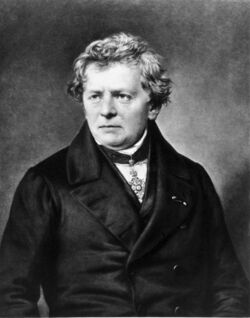
Early Life and Education
Georg Simon Ohm was born on March 16, 1789, in Erlangen, Bavaria, Germany. He came from humble beginnings — his father was a locksmith and self-taught in science and mathematics. Despite limited formal schooling, Georg received a strong foundation in math and physics thanks to his father’s teachings.
He entered the University of Erlangen in 1805 but left after three semesters due to financial hardship. He later worked as a private tutor in Switzerland while continuing his studies independently, reading works by Euler, Laplace, and Fourier.
🧪 Scientific Career and Discoveries
Ohm began teaching mathematics and physics at various schools, including the Jesuit Gymnasium in Cologne, where he had access to a well-equipped physics lab. It was here that he conducted experiments on electrical circuits using wires, batteries, and galvanometers.
In 1827, he published his groundbreaking book:
“Die galvanische Kette, mathematisch bearbeitet”
(The Galvanic Circuit Investigated Mathematically)
This work introduced what we now call Ohm’s Law, a fundamental principle in electrical engineering.
📐 Ohm’s Law and Mathematical Equation
Ohm’s Law describes the relationship between voltage (V), current (I), and resistance (R) in an electrical circuit:
plaintext V = I × R
- V = Voltage (Volts)
- I = Current (Amperes)
- R = Resistance (Ohms)
This simple yet powerful equation allows electricians to calculate how electricity behaves in a circuit. It’s the backbone of electrical theory and practice — from troubleshooting panels to designing safe installations.
🌍 Contributions to Humanity
Georg Ohm’s work laid the foundation for modern electrical engineering. His law made it possible to:
- Predict how electrical circuits behave
- Design safe and efficient electrical systems
- Develop technologies like motors, generators, and electronics
The unit of electrical resistance, the ohm (Ω), was named in his honor. His contributions continue to empower electricians, engineers, and inventors around the world.
🏅 Legacy
Though his work was initially met with skepticism, Ohm was later recognized with the Copley Medal by the Royal Society in 1841. He became a professor at the University of Munich and remained active in science until his death in 1854.
Today, Georg Simon Ohm is remembered as a pioneer whose curiosity and precision helped unlock the secrets of electricity — a true inspiration for every electrician.
Georg Simon Ohm: Pioneer of Electrical Resistance.
From Tutor to Experimenter
Ohm began his career teaching mathematics and physics at various schools in Germany. His big break came at the Jesuit Gymnasium in Cologne, where he had access to a well-equipped laboratory. There, he:
- Built simple circuits using wires, voltaic piles (early batteries), and galvanometers
- Carefully measured how current changed when he adjusted wire length, thickness, and material
- Recorded data with unprecedented precision, marrying theory and practice
These systematic experiments set the stage for his most famous discovery.
Ohm’s Law and the Iconic Equation
In 1827, Ohm published Die galvanische Kette, mathematisch bearbeitet (“The Galvanic Circuit Investigated Mathematically”). He distilled his findings into a single, elegant formula:
$$
V = I \times R
$$
Where:
- V is the voltage (in volts)
- I is the current (in amperes)
- R is the resistance (in ohms, Ω)
This law lets electricians predict how much current will flow through any given circuit element—critical for sizing wires, selecting breakers, and ensuring safe installations.
How That Equation Changed the World
Ohm’s Law is more than a classroom staple—it underpins nearly every electrical device we use:
- Designing home and commercial wiring to prevent overheating
- Calculating resistor values in electronics, from LED indicators to complex control boards
- Engineering motors, generators, and power-distribution systems
The unit of resistance, the ohm (Ω), honors his legacy every time an electrician checks a circuit.
Lasting Contributions and Legacy
Though his peers initially met Ohm’s work with skepticism, the clarity of his experiments eventually won acclaim. In 1841, the Royal Society awarded him the Copley Medal. Later, he became a professor at the University of Munich. When he died in 1854, he left behind:
- A standardized way to talk about and calculate electrical behavior
- A model of rigorous, data-driven experimentation
- Inspiration for future pioneers like Faraday and Maxwell
Ohm’s blend of mathematical insight and hands-on testing still guides electricians and engineers today.
Modern Applications of Ohm’s Law in Electrical Engineering
Overview
Ohm’s Law remains fundamental for predicting how current flows under a given voltage and resistance. Engineers rely on this principle across diverse technologies, from power networks to micro-scale circuits. Below are key modern applications highlighting its ongoing relevance.
Power Distribution and Grid Management
In high-voltage transmission systems, calculating line losses depends on accurate current and voltage drop estimations. Engineers use Ohm’s Law to size conductors and design protection schemes that minimize energy waste. Real-time grid monitoring tools also apply this law to detect faults by measuring abnormal voltage–current relationships.
Printed Circuit Board (PCB) Design
PCB layout demands precise trace width and copper thickness calculations to prevent overheating. By modeling each trace as a resistor, designers apply Ohm’s Law to predict temperature rise under expected currents. This ensures reliability in compact electronics where space constraints intensify thermal challenges.
Electronic Component Sizing and Circuit Design
Resistors, sensors, and amplifiers all rely on voltage–current predictions for proper function. Ohm’s Law helps determine resistor values for biasing transistors or setting LED currents. In instrumentation, it underpins shunt-based current sensing, where a known resistor produces a measurable voltage drop.
Battery Management Systems (BMS)
Effective BMS design depends on knowing how much current flows in and out of each battery cell. Ohm’s Law guides the selection of shunt resistors for precise current measurement, which in turn enables accurate state-of-charge calculations. It also aids in designing cell-balancing circuits by controlling charge/discharge currents.
Electric Vehicle (EV) Power Electronics
EV inverters and motor controllers use resistive elements for current sensing and braking resistors for energy dissipation. Ohm’s Law predicts the voltage drop across these components under high-power conditions. It also informs thermal management strategies to prevent overheating in power stages.
Renewable Energy Systems
In solar photovoltaic arrays, Ohm’s Law helps match panel string configurations to inverters by balancing voltage and current requirements. Engineers apply it within maximum power point tracking algorithms to optimize energy harvest. Wind turbine generator designs likewise use it for sizing cabling from nacelle to substation.
IoT Devices and Sensor Networks
Device longevity hinges on low-power operation, where minimal current draw is critical. Ohm’s Law assists in selecting pull-up and pull-down resistors in digital circuits to reduce standby power. It also underlies the design of simple analog sensors that convert physical parameters into voltage signals.
Structured Comparison of Applications
| Application | Example Use | Ohm’s Law Role |
|---|---|---|
| Power distribution | Transmission line loss calculation | Calculate current and voltage drop |
| PCB design | Trace width and copper thickness selection | Determining resistive heating |
| Battery management systems | Current measurement for SOC estimation | Sensing current via shunt resistors |
| LED lighting | Series resistor for LED modules | Ensuring correct forward current |
| EV power electronics | Motor drive resistor sizing | Controlling current in inverters |
| Renewable energy | MPPT and array configuration | Voltage-current relationship for arrays |
Summary and Further Exploration
From large-scale power systems to tiny IoT sensors, Ohm’s Law continues to provide the mathematical backbone for electrical engineering.