

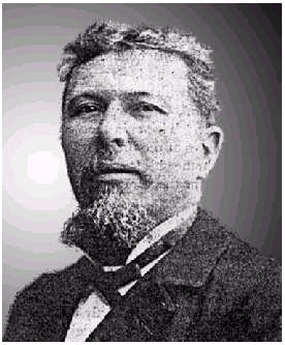
Thévenin was born on 30 March 1857 in Meaux, France. After graduating from the École Polytechnique in 1876, he joined the Corps of Telegraph Engineers. His interest in long-distance telegraph lines and measurement techniques culminated in the publication of Thévenin’s theorem in 1883 while he was a teaching inspector in Paris.
Thévenin’s theorem states that any linear circuit can be reduced to an equivalent voltage source V_{th} in series with an equivalent resistance R_{th}. The procedure is:
- Remove the load and find the open-circuit voltage (V_{th}).
- Deactivate all independent sources and calculate the resistance seen from the load terminals (R_{th}).
- Reconnect the load to the simplified V_{th}–R_{th} series circuit.
This method streamlines load analysis and design across changing conditions.
Thévenin’s insight revolutionized electrical engineering education and practice. By enabling rapid conversion of complex networks into simple two-element models, it empowers electricians and engineers to predict load behavior, optimize system performance, and facilitate modular, maintainable designs in marine, industrial, and commercial applications.
His Theorem:
- Thévenin Equivalent Circuit:
Any linear circuit can be simplified to:
V_{th} \text{ in series with } R_{th}
This makes it easier to analyze how a load will behave without recalculating the entire network.
🛠️ How It Helps:
- Speeds up troubleshooting
- Makes load analysis intuitive
- Essential for designing modular systems
🌍 Impact on Humanity:
Thévenin’s work revolutionized electrical engineering education and practice. His theorem is now a staple in textbooks and used daily by electricians, engineers, and students worldwide.
Why It Matters.
Whether you’re wiring a bilge pump or designing a lighting layout, these principles help you:
- Predict how current will flow
- Understand voltage drops
- Simplify systems for safer, smarter design
Thévenin’s Theorem Statement
“Any linear electrical network of voltage sources, current sources, and resistances can be replaced, when viewed from two terminals by a single equivalent voltage source (Thévenin voltage Vth) in series with a single resistance (Thévenin resistance, Rth).”