

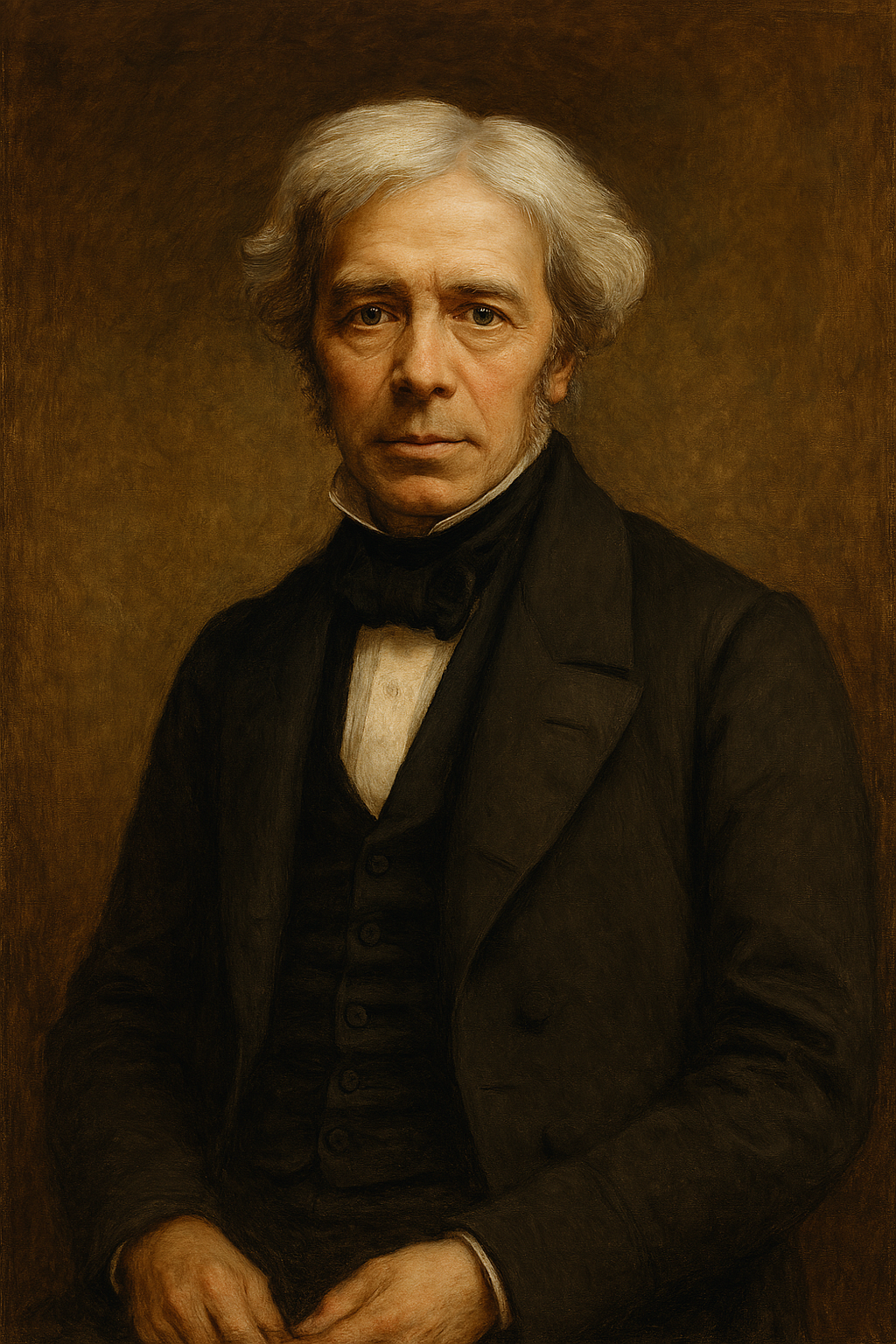
At the heart of every marine electrician’s toolbox lies a legacy of discovery that began with Michael Faraday. His experiments unlocked the fundamental principles of electricity and magnetism that power shipboard generators, motors, and navigation systems today.
Early Life and Humble Beginnings
Michael Faraday was born on September 22, 1791, in Newington Butts, a working-class district of South London. His father was a blacksmith and his mother ran a small household, leaving the family with limited means.
At age thirteen, Faraday became an apprentice bookbinder and stationer under George Riebau. In his spare time he pored over the books that passed through the shop, teaching himself arithmetic and basic science from textbooks and pamphlets.
An anecdote often told in the Royal Institution’s halls describes young Faraday taping together five volumes of Isaac Watts’s More Simple Lessons, poring over them by candlelight long after the bindery closed for the night.
Apprenticeship with Davy and First Forays into Science
In 1812, Faraday attended lectures by Sir Humphry Davy at the Royal Institution. He compiled detailed notes into a twelve-thousand-word manuscript and sent them to Davy with a polite request: “Sir, I beg to offer you these notes.”
Impressed by the accuracy and care of the manuscript, Davy hired Faraday as his laboratory assistant, despite Faraday having no formal education. Faraday’s first tasks included grinding optical lenses and maintaining chemical apparatus, but he quickly progressed to designing and executing simple experiments of his own.
Groundbreaking Research in Electricity and Magnetism
Faraday’s scientific contributions can be grouped into four pillars:
- Electrolysis and Faraday’s Laws (1834)
- First Law of Electrolysis: m = \frac{Q}{F} \cdot \frac{M}{z}
- Second Law of Electrolysis: Elements deposit in proportion to their equivalent weights.
- Electromagnetic Induction (1831)
- Discovery that a changing magnetic field induces an electric current in a nearby circuit.
- Mathematical form later encapsulated by
- This principle underlies modern shipboard alternators and motor generators.
- Faraday Cage and Field Concept
- Demonstrated that conductive enclosures block external electric fields, protecting delicate electronics aboard vessels.
- Pioneered the notion that electric and magnetic effects propagate through fields rather than direct “action at a distance.”
- Diamagnetism and Magnetic Rotation
- Showed that all materials respond to magnetic forces, leading to the invention of the Faraday disc generator—one of the first continuous current generators.
Overcoming Obstacles as a Man of Science
Faraday faced two major challenges:
- Lack of Formal Credentials:
He never attended university, which bred skepticism among gentleman scientists. He countered this by publishing meticulously documented experiments and inviting peers to replicate them. - Health and Workload:
Long hours in cold, damp labs led to bouts of illness. In 1839 he took a year-long “sanitary vacation,” returning stronger and more determined to refine his work.
His unwavering integrity and clarity of method gradually earned him membership in the Royal Society (1824) and, later, the title of Fullerian Professor of Chemistry at the Royal Institution (1833).
Legacy and Impact on Marine Electrical Engineering
Faraday’s discoveries form the blueprint for equipment found on every modern vessel:
- Shipboard Generators and Alternators:
The rotating magnetic field concept enables efficient power generation for lighting, radar, and propulsion systems. - Electric Motors:
Faraday’s motor experiments laid the groundwork for direct-current and alternating-current motors driving winches, pumps, and thrusters. - Protective Shielding:
Faraday cages in navigation consoles safeguard compasses and sensitive electronics from stray currents and lightning strikes.
His rigorous approach to experimentation inspires the meticulous testing and troubleshooting that apprentices practice during wiring installations and fault diagnosis.
Death and Posthumous Recognition
Michael Faraday died on August 25, 1867, at his home in Hampton Court. The Royal Institution lowered its flag to half-mast, and thousands paid their respects as his coffin passed through London streets.
Posthumously, Faraday’s name has been enshrined across scientific honors:
- The Faraday Medal by the Institute of Engineering and Technology
- The Faraday Constant (F = 96\,485\ \mathrm{C/mol}) in electrochemistry
- Faraday’s diaries and laboratory notebooks, still studied for their methodological insights
Beyond powering ships, Faraday’s legacy endures in every circuit schematic, troubleshooting log, and classroom demonstration. His curiosity, tenacity, and clear-cut approach to experimentation serve as a guiding light for every marine electrician apprentice embarking on their own voyage of discovery.
Further Exploration and Resources
- Visit the Royal Institution’s Faraday Museum online for interactive experiments.
- Study Faraday’s original Christmas Lectures, many of which introduced audiences to fundamental electrical concepts.
- Explore how James Clerk Maxwell mathematically formalized Faraday’s ideas in Maxwell’s equations—especially
- Consider designing a hands-on demonstration: wind coils around an iron core to illustrate induction, mirroring Faraday’s own experiments.
These next steps can deepen your understanding and help you carry forward Faraday’s spirit of innovation into the world of marine electrical engineering.
Overview
Here are key ways Michael Faraday’s discoveries underpin today’s electrical world—especially aboard ships and marine vessels:
- Shipboard Power Generation and Alternators
- Faraday’s law of induction
\mathcal{E} = -\frac{d\Phi_{B}}{dt}
describes how a rotating magnetic field in an alternator produces the voltage that powers lighting, radar, and navigation systems. - Modern marine alternators still use the same coil-and-magnet setups Faraday pioneered, just with advanced materials and electronic voltage regulators.
- Electric Motors and Thrusters
- Faraday built the first homopolar motor in 1821, proving electricity could generate continuous motion.
- Today’s DC and AC motors—whether driving cradle winches, bow thrusters, or bilge pumps—are direct descendants of his experiments.
- Variable-frequency drives (VFDs) on ships manipulate magnetic fields to control motor speed smoothly and efficiently.
- Voltage Transformation and Power Distribution
- Transformers step voltages up or down through mutual induction, a direct application of Faraday’s principles.
- On board, transformers balance the needs of heavy machinery and sensitive electronics, ensuring safe, stable power for everything from engine-start systems to navigation computers.
- Electromagnetic Shielding (Faraday Cages)
- Enclosures made of conductive metal, known as Faraday cages, block external electric fields.
- Navigation consoles, radar housings, and sensitive instrumentation panels are often enclosed or grounded to prevent electromagnetic interference (EMI) and lightning surges.
- Sensors, Inductive Pickups, and Non-Contact Measurements
- Inductive proximity sensors on cranes and hatch covers detect metal without physical switches, enhancing reliability in damp or corrosive marine environments.
- Torque and speed sensors in propulsion shafts use variable magnetic flux to produce electrical signals that feed into control systems.
6. Electrochemical Systems and Battery Technology
- Faraday’s laws of electrolysis underpin how charge moves in batteries and fuel cells.
- Battery banks on modern vessels—whether lead-acid, lithium-ion, or emerging flow batteries—rely on his quantitative relationships between current, time, and material deposition.
Practical Comparison
| Application Area | Principle | Marine Example |
|---|---|---|
| Power Generation | \mathcal{E} = -d\Phi/dt | Ship alternators for lighting and pumps |
| Electric Propulsion | Magnetic forces on current-carrying wire | Bow/stern thrusters with VFD control |
| Distribution & Transformation | Mutual induction | Step-up/step-down transformers for AC bus systems |
| Electromagnetic Shielding | Conductive enclosure effect | Faraday-shielded navigation and radar consoles |
| Inductive Sensing | Flux change → voltage | Proximity sensors on deck machinery |
| Battery Charging/Discharging | Faraday’s electrolysis laws | On-board battery charging systems |
Further Exploration
- Experiment with winding your own small coil and moving it through a magnetic field to light an LED—just like Faraday did.
- Study how modern generator excitation systems use feedback loops to maintain stable output.
- Explore wireless charging pads and induction cooktops as everyday examples of Faraday’s induction.
- Dive into how MRI machines in medical settings leverage magnetic resonance—another field-based offshoot of his work.
These applications show that Faraday’s insights aren’t just history; they’re the blueprint for every wire, motor, and sensor you’ll encounter on the high seas.
Michael Faraday’s Most Famous Quote:
“Nothing is too wonderful to be true, if it be consistent with the laws of nature.”