

A Beginner’s Guide for Marine AC generators—also called alternators—turn mechanical energy into the alternating current (AC) power that runs everything from your cabin lights to navigation electronics. In this tutorial, we’ll break down:
- What an AC generator is and how it works
- The key components you’ll find inside every alternator
- The major types of AC generators and where they’re used
What Is an AC Generator?
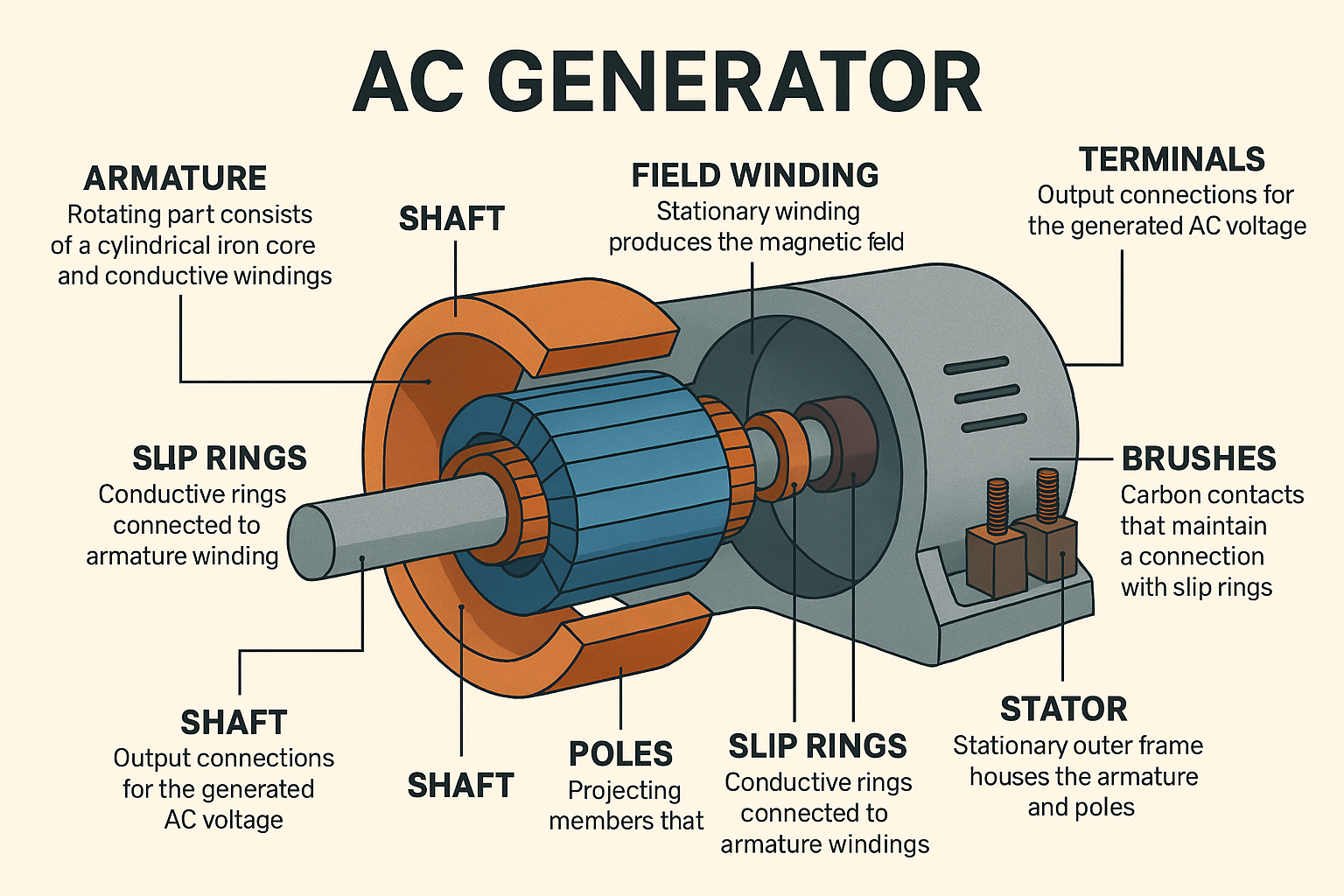
An AC generator converts rotational motion into a sine-wave voltage. On a boat, that motion often comes from a diesel engine or turbine driving the alternator’s shaft. As the rotor spins inside the stator windings, it creates a changing magnetic field that induces alternating voltage in the stator coils. That AC power then feeds your breaker panel, onboard instruments, and battery-charge circuits.
Core Components of an AC Generator
- Rotor (Field Assembly)
- Spinning element that carries the DC field winding.
- Creates the magnetic flux that “cuts” the stator coils.
- Stator (Armature Windings)
- Stationary ring of copper windings.
- Here is where the alternating voltage is induced and delivered to the load.
- Exciter
- Small DC generator mounted on or near the rotor shaft.
- Supplies field current to the rotor; can be brush-type or brushless (rotating rectifiers).
- Voltage Regulator
- Monitors output voltage and adjusts exciter field current.
- Keeps generator voltage steady under changing load and engine speed.
- Slip Rings & Brushes (if brush-type exciter)
- Provide electrical connection between the stationary regulator and the rotating field winding.
- Bearings & Shaft
- Support and align the rotor; critical for smooth, vibration-free operation.
- Cooling System
- Air or liquid passages to keep windings and bearings within safe temperature limits.
Types of AC Generators
- Synchronous Generators
- Rotor speed is locked in step with line frequency (50 Hz or 60 Hz).
- Requires precise control of engine speed or prime mover governor.
- Common in large marine gensets and shore-power plants.
- Induction (Asynchronous) Generators
- Rotor speed runs slightly above or below synchronous speed; slip induces output current.
- Often self-excited with external capacitors or wound-rotor controllers.
- Used in small wind turbines, portable gensets, and some marine applications where simplicity is key.
- Brushless vs. Brush-Type Alternators
3. Brushless vs. Brush-Type Alternators
| Feature | Brushless Exciter | Brush-Type Exciter |
|---|---|---|
| Maintenance | Lower (no brushes to wear) | Higher (periodic brush replacement) |
| Complexity | More complex assembly | Simpler, fewer rotating parts |
| Reliability in Marine | Excellent—less sparking in damp air | Good—but brushes need corrosion care |
4. Permanent‐Magnet Alternators (PMAs)
- Use strong permanent magnets instead of field windings.
- Very simple: no exciter or field circuit.
- Output varies with speed; often paired with electronic regulators.
- Ideal for small emergency units and renewable hybrid systems.
Quick Comparison Table
| Type | Excitation Method | Speed Control | Marine Use Cases |
|---|---|---|---|
| Synchronous | DC exciter or brushless | Exact (governor-controlled) | Main gensets, shore-tie systems |
| Induction | Capacitor or wound-rotor | Moderate (slip-based) | Backup gensets, small turbines |
| Brushless Alternator | Rotating rectifier | Depends on exciter | Mid-size gensets—low maintenance |
| Brush-Type Alternator | Stationary rectifier | Depends on exciter | Simple, budget-friendly installations |
| Permanent‐Magnet | Permanent magnets | Electronic regulation | Small portable or renewable units |