

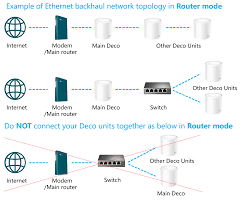
In a mesh Wi-Fi system, backhaul is the connection that links the satellite nodes (the extra units) back to the main router node. This carries all the data traffic between nodes.
- Wireless backhaul (default for most mesh systems): Nodes communicate with each other over Wi-Fi. This is convenient but can halve bandwidth (since the same radio bands handle both node communication and your devices) and introduce interference or slower speeds.
- Wired backhaul (also called Ethernet backhaul): You connect the nodes to the main router (or to each other via a switch) using Ethernet cables.
Here’s a simple diagram showing a typical wired backhaul setup:
General questions about Ethernet Backhaul feature on your Deco …
And another illustration of how nodes are linked with Ethernet cables:

How to add Wifi mesh network with ethernet backhaul to wired home …
Key Benefits of Wired Backhaul
If your home has existing Ethernet wiring (or you’re willing to run cables), wired backhaul is almost always superior to wireless. Here’s why:
- Higher Speeds and Full Bandwidth Utilization Wireless backhaul often shares bands with your devices, cutting available speed (e.g., a node might only get half the bandwidth). Wired frees up all Wi-Fi bands for your phones, laptops, and smart devices, delivering faster real-world speeds—often 50-100%+ improvements in downloads/uploads.
- Lower Latency and More Stability Ethernet connections are rock-solid with minimal interference, perfect for gaming, video calls, or 4K streaming. No signal drop-offs from walls or distance.A performance graph comparing wired vs. wireless backhaul (wired shows significantly better range and speed):

Wired vs Wireless Backhaul – RTINGS.com
- Better Reliability and Less Interference Wi-Fi backhaul can suffer from congestion or “noise” in busy environments. Wired eliminates this, providing consistent performance even with many devices connected.
- Improved Coverage Placement With wireless, you place nodes where they get a strong signal from the main router. With wired, you place them exactly where coverage is weakest (e.g., far corners or basements)—no need to compromise for backhaul strength.
- Future-Proof for Faster Internet If you have gigabit+ internet, wired backhaul (especially Gigabit or higher Ethernet) prevents bottlenecks that wireless might create.
When Is It Worth It?
- Yes, if: You have Ethernet ports in walls, can run cables easily, or want maximum performance.
- Stick to wireless if: Running cables is impossible (e.g., rented home, thick walls) or your internet speed is under 500 Mbps—wireless is “good enough” for most casual use.
Many modern mesh systems (like TP-Link Deco, Google Nest, Eero, or Netgear Orbi) support wired backhaul automatically—just plug in the cables, and the app detects it.
If you’re setting up a mesh and have the option, go wired where possible—you’ll notice the difference! Let me know if you need help with a specific brand.